 Cahaba Water Co.
The free water test that arrives in the mail.
Every water treatment company in America offers a free water test. Ours comes to you by mail. You test your own water at your own sink, you keep the number, and you decide what to do with it.
The test tells you what your water is carrying and how hard it runs, which is what decides the system. Chlorine reaches every tap in the house, and the shower, not the drinking tap, is where most of the exposure happens.
A simpler way to find out
Most water testing is done in your kitchen, by someone who also quotes the system. Ours arrives in the mail. You test your own tap, the number is yours to keep, and you decide what to do with it, including taking it to somebody else.
- A test strip in the post, free, with no appointment
- A result that belongs to you
- A conversation when you want one, on your timing
- A firm written price after we measure the house
- Hardness varies by source and location, so the number has to come from your tap
- A measurement settles what a conversation cannot
- We would rather you read the result in your own time than over our shoulder
If you want the detail on how in-home water treatment sales typically work, with sources, we have written it up separately.
Why treat the whole house and not just the kitchen tap
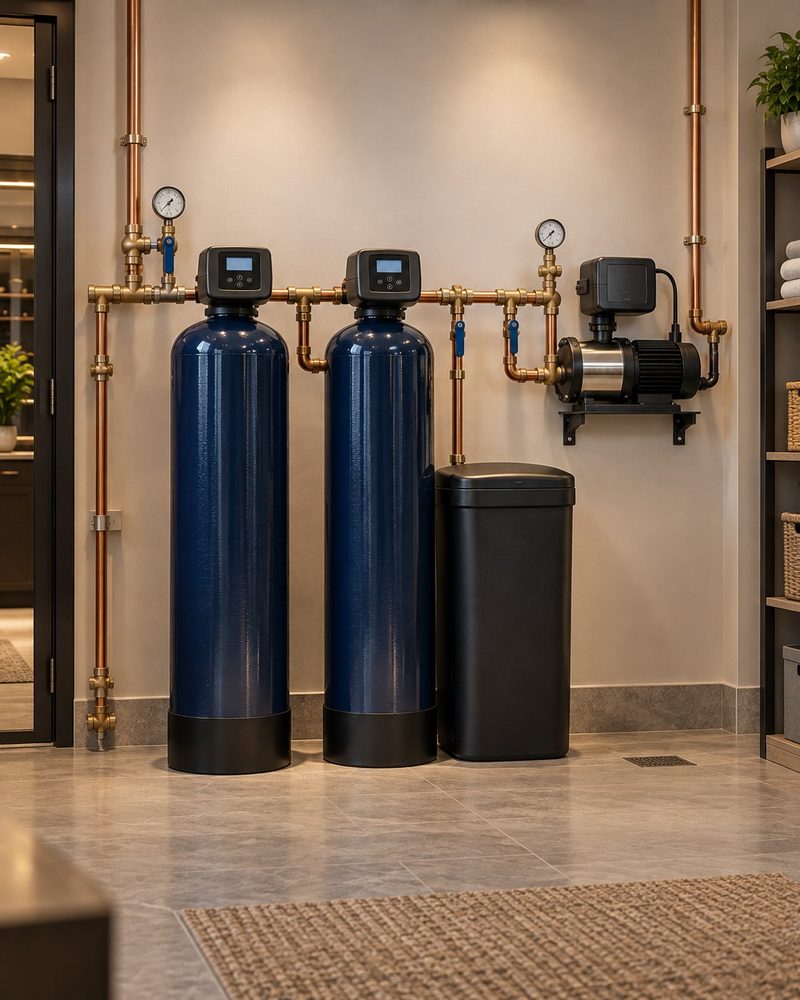
Because the shower, not the drinking tap, is where most of your contact with chlorination byproducts happens. This is the measurement that makes the case, and it is somebody else's.
- Blood trihalomethanes rose by about 20 pg/mL
- Point-of-use reverse osmosis handles this tap well
- Blood trihalomethanes rose by 358 pg/mL, roughly eighteen times the drinking figure
- The mechanism is physics, not chemistry: hot water in a steam-filled enclosure moves volatile compounds into the air you breathe
- A filter at one tap cannot reach this. The shower is on the main line
Measured in a peer-reviewed 2005 study in Environmental Health Perspectives. In Central Alabama Water's 2026 Annual Water Quality Report, covering 2025 testing, the highest locational running annual average for trihalomethanes was 63.3 µg/L against a legal limit of 80, compliant and not zero. This is an exposure measurement rather than a health claim, and that is exactly how we present it. The full article, with the citation, is here.
What whole-home treatment actually changes
- Chlorine at every tap Shower, bath, laundry and kitchen, not one fixture. Carbon on the main line is what does this.
- Sediment before it reaches anything Water heaters, valves, fixture cartridges and the small orifices in appliances all sit downstream of the main.
- Hardness, where your test supports it Spotting on glass, film on fixtures, soap performance and scale in a water heater. At the hard end of what this metro publishes that is a daily difference; at the soft end there is little for a softener to work on. Your test says which end you are on.
- Drinking water, still at the tap Whole-home carbon is not a substitute for reverse osmosis at the kitchen sink. The two do different jobs, and Complete includes both.
If PFAS is the reason you're here
Then the answer is more specific than "a whole-home system". Start with what the utility publishes: in the 2026 Annual Water Quality Report, Central Alabama Water's highest PFOS result was 3.8 parts per trillion and its highest PFOA result 2.7, against a federal limit of 4.0 for each. Compliant, and detected. If that is your reason for calling, here is exactly which part of the system carries a certification for those two compounds.
The certification is real, and it belongs to one configuration. IAPMO R&T certifies the Cahaba Pure 50 to NSF/ANSI 58 and CSA B483.1, including PFOA and PFOS reduction, minimum 98.77%, average 99.26% on the manufacturer's performance data sheet
A certification belongs to the configuration that was tested. Whole-home carbon carries no PFOA or PFOS listing of its own, so we keep that claim where it was earned
So the route is the drinking tap. The exposure that matters for these compounds is ingestion (drinking and cooking) which is a point-of-use problem with a point-of-use answer
PFAS is thousands of compounds, and this certification names two of them. We describe the result the way the listing does: certified reduction of PFOA and PFOS, which is a narrower statement than the phrase most advertising uses
This is what Complete is for. Cahaba Whole Home Complete pairs whole-home carbon (which handles chlorine at every tap, including the shower) with an under-sink reverse osmosis system at the kitchen. If PFAS is your reason for calling, say so, and ask for the Pure 50 as that RO. The certification above comes with that specific configuration, and we will hand you the data sheet.
One system covers the route you breathe. The other covers the route you drink. They are genuinely different jobs, which is why we quote them as two decisions rather than one.
What a whole-home system actually decides
Two questions, and they are independent of each other. Answering them separately is how you end up with a system sized to your water and your plumbing rather than to a round number.
What does your water need treated?
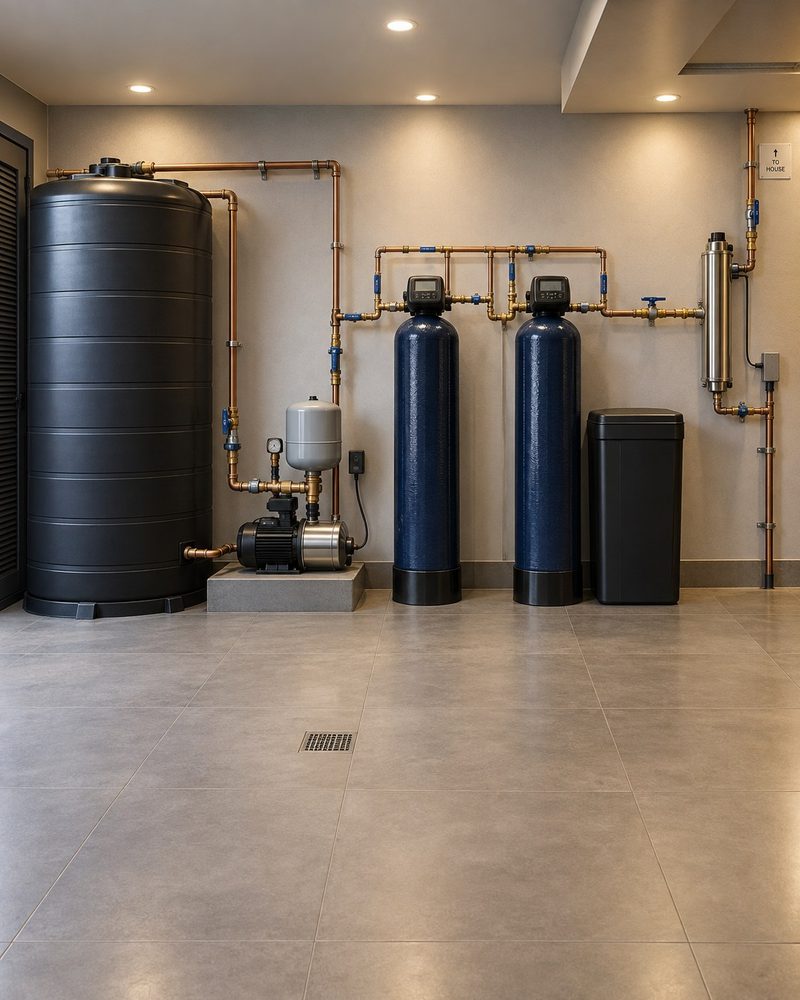
Carbon for chlorine taste and odor at every tap. Softening where the measured hardness level and your own goals justify it, because hardness here varies by source and location, so the test is what settles it. UV where it genuinely belongs, which on treated municipal water is rare. This follows your water, not your house.
How much water must the house move?
Your incoming service line, your bathroom count, how many showers run at once, body sprays and soaking tubs, laundry and dishwasher use. This is a hydraulic question and it is measured on site; it comes from the plumbing, not from square footage or a ZIP code.
A water softener isn't automatic in Birmingham. Hardness varies by water source and location. Central Alabama Water (formerly Birmingham Water Works) publishes total hardness of 38 to 224 mg/L across its system in its 2026 Annual Water Quality Report, roughly 2.2 to 13.1 grains per gallon, which is slightly hard at one end of the system and very hard at the other, from a single utility. Set that beside Trussville at 8.9 system-wide and Pelham reaching 11.9 and the spread inside Central Alabama Water is wider than the gap between utilities. Two houses eleven miles apart can need genuinely different equipment.
So we test your home's water before recommending a softener. If the number is low, we'll tell you. If the hardness level and your goals justify softening, we size the system to your result.
How this goes
You tell us where to mail it
Name and address. We ask for the address for one reason: we are mailing you something.
You test your own water
It takes about a minute at the kitchen tap. The result is yours to keep and yours to shop around with.
We talk, if you want to
Call, text or email us the number and we will tell you what it means for your house and which system it points to. You get a straight answer, and what happens next is yours to decide, on your timing.
Then we measure the house
Only if you are going ahead. Service line, fixtures, pressure standing and under load. The price goes in writing before anything is scheduled, and a licensed Alabama plumbing contractor does the installation.
Whole-home pricing comes after we measure your house. The equipment differs house to house, so a figure quoted before we have seen your plumbing would be a guess wearing a price tag. Our drinking-water prices are published in full, because those we can state honestly without seeing your plumbing.
Mail me the free test
Free, mailed to your door, and the result is yours to keep. No obligation.
Installation is performed by an Alabama-licensed plumbing contractor. Serving Greater Birmingham.
Questions first? Call or text (205) 825-8810.