 Cahaba Water Co.
You absorb more disinfection byproducts in a ten-minute shower than from a day of drinking the water
It sounds like a sales line. It is actually a measured finding, published in Environmental Health Perspectives — and the number is larger than most people expect.
The short version
- A 2005 study measured blood THM levels after specific household activities. Showering raised them by 358 pg/mL. Drinking cold tap water raised them by about 20 pg/mL.
- The mechanism is physics, not chemistry: hot water plus a steam-filled enclosure moves volatile compounds into the air you breathe.
- This is about trihalomethanes — byproducts of chlorination — not chlorine itself. The distinction matters.
- Central Alabama Water's highest locational running annual average for TTHM is 63.3 µg/L against a limit of 80. Compliant, and not zero.
- Treating it means treating the water where it enters the house. It is the one water problem that genuinely calls for point-of-entry equipment.
There's a claim that circulates in the water treatment industry, and it gets repeated so often, with so little sourcing, that most people reasonably assume it's marketing. It goes roughly: you absorb more chlorine in a ten-minute shower than you do from drinking eight glasses of tap water.
I want to be careful here, because the claim as usually stated is imprecise in a way that matters. But the underlying finding is real, it's peer-reviewed, and the actual numbers are more striking than the slogan.
What the research actually measured
In 2005, a team led by John Nuckols published a study in Environmental Health Perspectives that did something unusual. Rather than modeling exposure, they measured it — taking blood and exhaled-breath samples from participants before and after specific household water activities, at two sites with different trihalomethane levels in the supply.
They had people shower. They had people bathe. They had people wash dishes by hand. And they had people drink a glass of cold tap water. Then they measured what showed up in the bloodstream.
That is roughly an eighteenfold difference. Bathing came in at 164 pg/mL. Hand dishwashing — which nobody thinks of as an exposure event at all — produced 98 pg/mL, still around five times the drinking figure.
The authors' own summary is blunt: activities associated with inhaled or dermal exposure routes result in a greater increase in blood THM concentration than does ingestion. Showering and bathing consistently produced at least a twofold increase in median blood and exhaled-breath THM levels, and that held regardless of how much THM was in the water supply to begin with.
Why a shower does this and a glass of water doesn't
The mechanism is simple once you see it, and it's worth understanding because it explains what each of the usual solutions can actually reach.
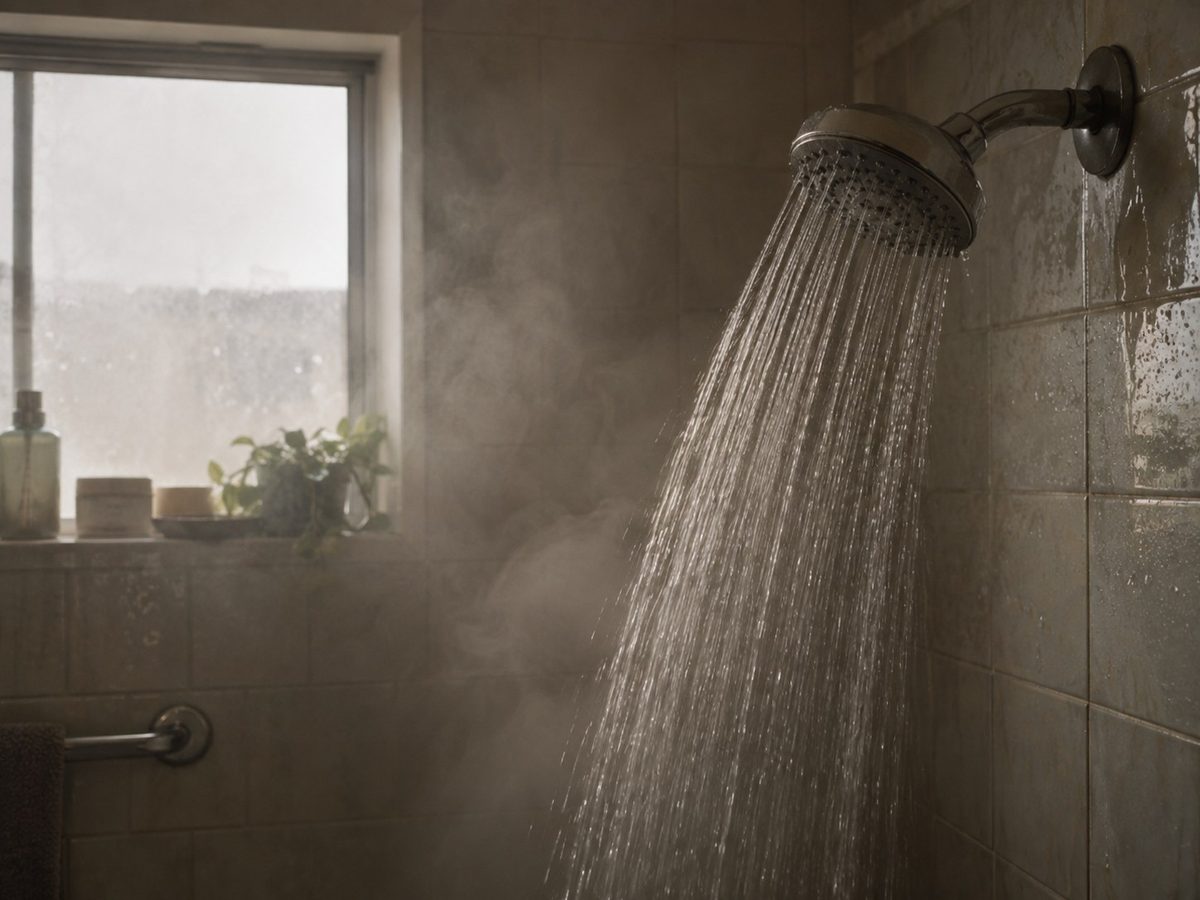
Trihalomethanes are volatile. They evaporate readily, and heat accelerates it. When you run a hot shower you are, functionally, operating a small stripping column: water is atomized into droplets with an enormous combined surface area, heated, and released into a sealed room you're standing in. The compounds leave the water and enter the air. Then you breathe that air, at an elevated rate, for ten minutes, with warm skin and open pores adding a second absorption route.
Drinking a glass of water is the opposite situation in almost every respect. The water is cold, there's no aerosolization, the volume is small, and it goes through your digestive system, where the liver gets a pass at it before it reaches general circulation.
Same water. Two very different exposure events.
The distinction that actually matters: chlorine versus what chlorine makes
Here's where the popular version of this claim gets sloppy, and where I'd rather be accurate than punchy.
The research above measured trihalomethanes, not free chlorine. Those aren't the same thing. Chlorine is the disinfectant your utility adds. Trihalomethanes are what form when that chlorine reacts with naturally occurring organic matter in the water — leaf litter, algae, the ordinary organic load of any river or lake.
This distinction matters for two reasons.
First, chlorine itself is not the villain of this story. It's the reason waterborne disease is largely historical in this country. The EPA sets a Maximum Residual Disinfectant Level of 4.0 mg/L for chlorine precisely because the agency has weighed the microbial risk against the chemical one and concluded that disinfection wins, decisively. That trade is the right one, and it deserves saying plainly before any discussion of byproducts.
Second, and more practically: Birmingham draws entirely from surface water — the Cahaba, the Little Cahaba, Lake Purdy, Inland Lake, the Black Warrior basin. Surface water carries a far higher organic load than groundwater. More organic matter reacting with chlorine means more disinfection byproducts. It's an unavoidable consequence of the source, not a failure of the utility.
Where Birmingham actually sits
From the Central Alabama Water (formerly Birmingham Water Works) 2026 Annual Water Quality Report, covering testing performed January through December 2025:
| Parameter | Highest LRAA | Range of individual results | Limit (as LRAA) |
|---|---|---|---|
| Total trihalomethanes | 63.3 µg/L | 17.7 – 80.6 µg/L | 80 µg/L |
| Haloacetic acids (HAA5) | 37.8 µg/L | 5.52 – 43.6 µg/L | 60 µg/L |
Read that carefully, because the honest reading is more interesting than either extreme.
Central Alabama Water is compliant. For these two byproducts, compliance runs on the locational running annual average — four consecutive quarters of results averaged at each monitoring location — and the highest of those averages was 63.3 µg/L against a limit of 80. The utility reports meeting every state and federal water quality regulation for 2025, and the published data supports that.
The individual results behind those averages are where the texture is: they span 17.7 to 80.6 µg/L across the monitoring sites. A single sample is not the compliance measure, and the four-quarter average is the right yardstick for judging a utility. It is still the water that came out of a tap on the day it was drawn.
Byproduct formation varies across a distribution system — it tends to climb the longer water sits in the pipes, so homes at the far end of a run typically see more than homes near the plant. Your house has a number. The system average is not necessarily it.
How far each obvious fix reaches
Once you understand the mechanism, the reach of each common countermeasure becomes easy to place.
- A pitcher filter treats the water you pour into it, which is drinking water and nothing else in the house.
- An under-sink reverse osmosis system — which we sell, and which is genuinely excellent for drinking water — treats one tap. It's the right answer for taste, and it's the right answer for the contaminants it's certified to reduce. Its job ends at that tap.
- A showerhead filter is a partial answer, and it earns that much. The constraint is physical: a cartridge that small, at shower flow rates, gives the water a contact time measured in fractions of a second. Expect some reduction, briefly, tapering as the cartridge loads.
This is the one water quality issue where the equipment genuinely has to sit at the point where water enters the house rather than where it leaves it. Not because that's a bigger sale — because a filter downstream of the shower valve cannot treat the shower.
What point-of-entry carbon actually does
A whole-home activated carbon filter installs on your main line, upstream of everything. Every fixture in the house draws through it — showers, baths, the washing machine, the kitchen tap.
Granular activated carbon is genuinely effective at reducing free chlorine, and reduces the byproducts formed before the water reached your house. Remove the chlorine at the point of entry and you also stop further byproduct formation inside your own plumbing.
Two things are worth knowing before you buy one.
Size does the work. Carbon works by contact. Push too much flow through too little media and the water channels — finds a path through the bed and exits substantially untreated — at exactly the moment the house is busiest. This is why we size carbon on measured design peak flow rather than on house square footage, and why a 2.5 cubic foot bed and a 4.0 cubic foot bed are genuinely different products.
Carbon has a defined job. It reduces chlorine taste and odor well, and it covers every fixture while it does it. Softening is separate work. PFOA and PFOS belong to a point-of-use RO. The seasonal musty note from geosmin comes down partway at full household flow, for the same contact-time reason.
So how much should you actually care?
Honestly? That depends on how you weigh a modest, well-characterized long-term risk against roughly the cost of a decent appliance. The utility is doing its job, and this is a question of degree rather than an emergency.
The part worth reconsidering is the framing that treats drinking water as the whole question. The research is unambiguous that for volatile disinfection byproducts, ingestion is the smaller exposure route — by a wide margin. If you've been thinking about this purely in terms of what you drink, you've been thinking about the minority of it.
A drinking water filter handles drinking water, and handles it very well. The shower is a separate problem with a separate solution, and it is worth deciding on it separately.
Chlorine at every tap, not just the kitchen
Whole-home carbon filtration sized to your home's measured peak flow. We'll tell you what size you actually need — which is often smaller than you'd expect.
See Whole Home EssentialQuestions we get about this
Do you really absorb more chlorine in the shower than from drinking water?
Does a shower filter solve this?
Is Birmingham's water safe to drink?
Will a reverse osmosis system fix shower exposure?
Sources
- Nuckols JR, Ashley DL, Lyu C, Gordon SM, Hinckley AF, Singer P. "Influence of Tap Water Quality and Household Water Use Activities on Indoor Air and Internal Dose Levels of Trihalomethanes." Environmental Health Perspectives 2005;113(7):863–870. PMC1257647
- US EPA. National Primary Drinking Water Regulations — Maximum Residual Disinfectant Levels and DBP standards.
- US EPA. Disinfectants and Disinfection Byproducts Rules (Stage 1 and Stage 2) — Plain English Guide.
- Central Alabama Water (formerly Birmingham Water Works). 2026 Annual Water Quality Report (testing performed January – December 2025) — trihalomethane and haloacetic acid locational running annual averages.