 Cahaba Water Co.
Why your ice is cloudy, and whether a filter actually fixes it
Two of the five common causes are service calls, not filtration. Here is how to tell which one you have before you spend anything.
The short version
- Look at where the cloud sits in the cube. It identifies the cause faster than any test.
- Cloudy all the way through, suddenly is almost always mechanical. A filter will not fix it.
- Central Alabama Water publishes 2.2–13.1 gpg — slightly hard at one end of the system, very hard at the other. A range that wide is a reason to test your own line.
- Descaling and sanitation fail more inspections than water quality does. If you can only fix one thing, fix the cleaning schedule.
An ice machine that has always made clear cubes starts making cloudy ones. Nothing else changed. Somebody suggests a water filter, somebody else says the machine is dying, and a third person says it is just the water this time of year. One of those is usually right, and you can work out which in about ten minutes without buying anything.
Why clear ice is clear in the first place
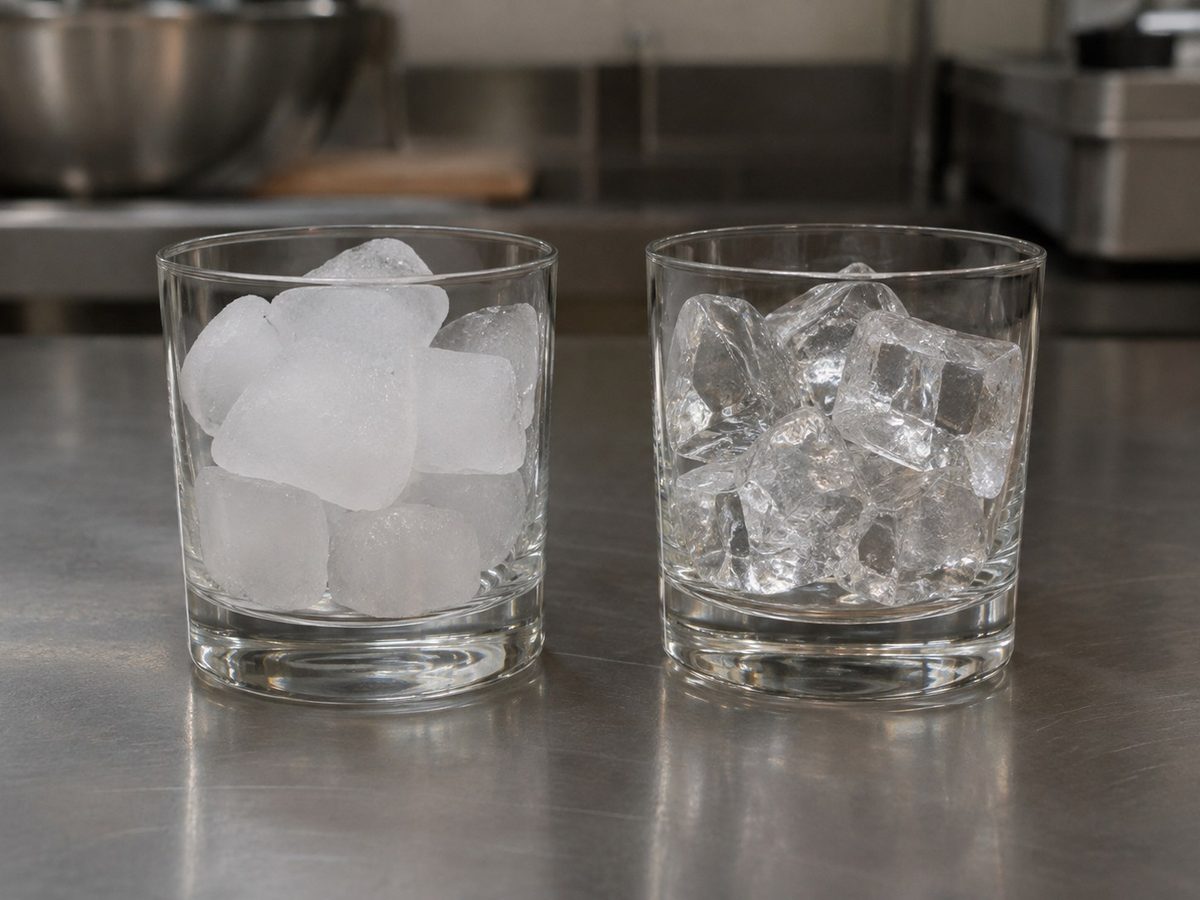
A commercial ice machine does not freeze a tray of water. It runs water continuously over a chilled plate, and ice builds up in thin layers. Because the water keeps moving, dissolved minerals and air stay in the moving water instead of getting trapped in the ice. Whatever does not freeze drains away.
That is the entire trick, and it is why commercial ice is clear and the ice in your home freezer is not. Cloudiness is the machine failing to reject something — and the useful question is what.
The ten-minute diagnosis
Pull a cube and look at where the cloud sits. It tells you most of what you need.
| What you see | Usually means | Does a filter fix it? |
|---|---|---|
| White core, clear edges | Normal, or slightly elevated dissolved solids. The center freezes last, so whatever is left concentrates there. | Sometimes, at the margin |
| Cloudy all the way through, suddenly | The machine. Low water flow over the plate, a failing water pump, or a dirty distribution tube starving part of the plate. | No. Service call. |
| White flecks that settle in the glass | Scale shedding off the machine's own internals. | Partly — but the machine needs descaling first |
| Soft, wet, fast-melting cubes | Harvest cycle timing or refrigerant, not water. | No. Service call. |
| Cloudy and tastes off | Water. Chlorine, or something seasonal in the supply. | Yes, this is the filter case |
Two of those five are service calls, not filtration. Ten minutes with a cube tells you which half of the problem you are in, and that is what keeps the money in the right place.
The part that is specific to Birmingham
Most cloudy-ice advice online is written around a single hardness number. This metro does not have one, and that is the useful thing to know before you spend anything.
Central Alabama Water (formerly Birmingham Water Works) draws entirely from surface water and publishes a total hardness range of 38 to 224 mg/L in its 2026 Annual Water Quality Report — roughly 2.2 to 13.1 grains per gallon. The low end of that range is slightly hard. The high end sits above 10.5 grains, which the standard classification calls very hard. That is one utility with a spread of nearly six to one, and a published range that wide cannot tell you which end your building sits on. A test on the line feeding the machine can, and it is the cheapest number in this whole decision.
Hardness is only half of what a surface supply brings to a cube. Chlorine is present year-round, and in spring the reservoirs can produce geosmin, which people detect at a few parts per trillion. Ice concentrates flavor because it sits in the drink while it melts. A cube made from water that tasted faintly of chlorine will hand that back to the customer over ten minutes.
Knowing your utility narrows it; the building settles it. Trussville publishes 8.9 grains per gallon system-wide. Pelham runs from 4.4 to 11.9 depending on supply, and Alabaster from 5.0 to 11.4. Every one of those figures falls inside the range Central Alabama Water publishes for its own system, so in this metro the answer turns on the address rather than the town line. Here is what each system publishes.
What an ice machine filter actually does
A typical commercial ice filter does three distinct things. Keeping them separate is what makes the purchase decision clear.
- Sediment removal. Keeps particulate out of the machine's water path. Genuinely protects the equipment.
- Carbon for chlorine taste and odor. This is the one that changes what your customer tastes. It is also the one most worth having in Birmingham.
- Scale inhibition, usually polyphosphate. Note the word inhibition. It sequesters hardness so it is less likely to deposit. It does not remove hardness, and it is not a softener.
- It does not clean a dirty machine. If there is already scale on the evaporator plate, filtration from today forward does nothing about the scale from last year.
- It does not fix mechanical problems. See the table above.
The order that actually saves money
We get called into this problem in the wrong order constantly. Here is the order that works:
1. Look at the cube
Ten minutes, free, and it eliminates the two mechanical causes immediately.
2. Check when the machine was last descaled and sanitized
Manufacturers generally specify this at least twice a year. If nobody can tell you the last time, that is your answer and it is not a filtration answer.
3. Check the filter you already have
A filter past its capacity is worse than no filter, because the pressure drop across it starves the machine. Most kitchens we walk into have one and nobody knows when it was changed.
4. Then talk about water
By this point you know whether water is actually the variable. If it is, we test rather than guess, and sometimes the answer is a cartridge change rather than a system.
When reverse osmosis is the right answer for ice
Sometimes it genuinely is, and it is worth saying when, because RO on an ice machine is a real expense and a real ongoing cost.
RO makes sense when the ice is a visible part of the product — a cocktail bar where the cube is on display, a coffee shop doing iced pour-over, a caterer whose ice sits in front of people on a table. It makes sense when your dissolved solids are high enough that the cloudy core persists after the machine is clean and the carbon is fresh. And it makes sense when you have already spent money twice on the wrong fix.
It is a considered choice rather than a default. For most kitchens in this metro, a clean machine and a fresh carbon cartridge settle the question. If a quote for RO arrives before anyone has asked when the machine was last descaled, ask for the diagnosis first.
One more thing about the machine you already own
Ice machines fail an inspection more often for sanitation than for anything to do with water quality. Biofilm in the reservoir and on the distribution tubes is the common finding, and it is the one that gets written up. Filtration does not prevent it — scheduled cleaning does. If you are going to spend money on the ice machine this quarter and you have to pick one, pick the cleaning schedule.
If the ice is still cloudy once the cleaning is current, that is the point at which testing the water earns its keep. In that order, the money lands where it does something.
Not sure whether it is the water or the machine?
We will test the line that feeds your machine and tell you plainly if the answer is a service call. Either way, you will know what you are buying before you buy it.
Commercial water treatmentQuestions we get about this
Why is my restaurant's ice machine making cloudy ice?
Will a water filter fix cloudy ice?
Is Birmingham water hard enough to scale an ice machine?
Does an ice machine need reverse osmosis?
How often should a commercial ice machine be descaled?
Sources
- Central Alabama Water. 2026 Annual Water Quality Report — total hardness and source water.
- Trussville Gas & Water, Pelham Water Works and Alabaster Water Board Consumer Confidence Reports — hardness figures, summarized here.