 Cahaba Water Co.
Two decisions. One properly sized system.
Every whole-home system we build answers two separate questions. What does your water need treated? And how much water does your house use at once? Two different questions, each with its own answer, and we measure both before we build anything.
what your water needs
what your home demands
readings at your house
Two tracks. They run beside each other, and each reaches its own answer.
One track decides what gets treated. The other decides how big the system is.
A simpler way to buy water treatment: two questions, answered separately, in front of you. Rolling them into one package price is how a house ends up carrying treatment nobody asked for, or how the right treatment ends up choked by a system that is too small.
Treatment level
What does this homeowner want or need treated?
- 01Start with the water and the goals
Three things set the scope. What Central Alabama Water (formerly Birmingham Water Works) publishes for your supply. What you can taste or smell. And what you actually want changed.
- 02Test where testing decides something
Hardness is the clearest example. We test hardness before recommending a softener, and the measured number is what settles it.
- 03Choose the level your water calls for
Three levels: Cahaba Whole Home Essential, Cahaba Whole Home Complete or Cahaba Whole Home Signature. The level describes scope: how much of the house gets treated, and for what.
This track reads your published water report, what you can taste and smell, and the goals you have for the house.
System size
How much water must this home handle at peak demand?
- 01Measure the house, not the listing
We measure the service line, the pipe that brings water in from the street. Then we count the fixtures that really move water: body sprays, soaking tubs, laundry, dishwasher.
- 02Take real pressure readings
We take static and dynamic pressure at the house. Dynamic is the reading taken while water is moving. It tells us what happens when three things run at once.
- 03Size to peak demand
Four sizes: S Standard Flow, M Enhanced Flow, L High Flow or XL Estate Flow. We pick one against what the build needs. That includes the backwash rinse that cleans the filter media.
This track reads the service line, the fixture count and the pressure at the house. A size is a plumbing answer to a plumbing question.
Treatment level is about what gets treated. Chlorine taste and odor at every tap. Hardness, where testing and your own goals call for a softener. A drinking-water system at the kitchen sink. And UV as an extra barrier, where it fits.
System size is about how much water moves through. The equipment has to pass your peak demand while staying out of the way of your plumbing. Size it to the flow your house actually creates and the shower stays strong, the media gets the flow it needs, and you pay for capacity the home will use.
Three treatment levels. Four sizes. Twelve legitimate systems. Whole home
Treatment level down the side, system size across the top, and twelve correct answers.
Read down for what gets treated. Read across for how much water the system passes. Every treatment level comes in every size, and a finished build is named for both. A Cahaba Whole Home Complete at Enhanced Flow is written Cahaba Whole Home Complete ‑ M.
| SStandard Flow | MEnhanced Flow | LHigh Flow | XLEstate Flow | |
|---|---|---|---|---|
| Cahaba Whole Home Essential Carbon filtration at every tap. Add a softener where testing calls for one, and a drinking-water system whenever you want it. | Cahaba Whole Home Essential ‑ S | Cahaba Whole Home Essential ‑ M | Cahaba Whole Home Essential ‑ L | Cahaba Whole Home Essential ‑ XL Example A — below |
| Cahaba Whole Home Complete Carbon filtration at every tap, a softener if your water needs one, and a Cahaba under-sink RO. | Cahaba Whole Home Complete ‑ S | Cahaba Whole Home Complete ‑ M | Cahaba Whole Home Complete ‑ L | Cahaba Whole Home Complete ‑ XL |
| Cahaba Whole Home Signature The most complete system we build, designed around your house. The widest set of options, configured to what your water and your goals call for. | Cahaba Whole Home Signature ‑ S Example B — below | Cahaba Whole Home Signature ‑ M | Cahaba Whole Home Signature ‑ L | Cahaba Whole Home Signature ‑ XL |
Every cell in this grid is a finished system. Twelve combinations, each one correct for the house it belongs to. Your two readings pick the cell.
The price follows the build, and the build follows the measurements: Quoted after sizing.
The two marked cells are the two homes described below. They sit in opposite corners. That is the shortest way to show that the two decisions are independent.
We size your system from your home's actual water demand, measured at the house.
Cahaba Water Co. — how we quote
The big house takes the small package. The small house takes the big one.
A big house can need our simplest system. A small house can need our most complete one.
These two cases break the assumption, and both of them are ordinary Birmingham houses.
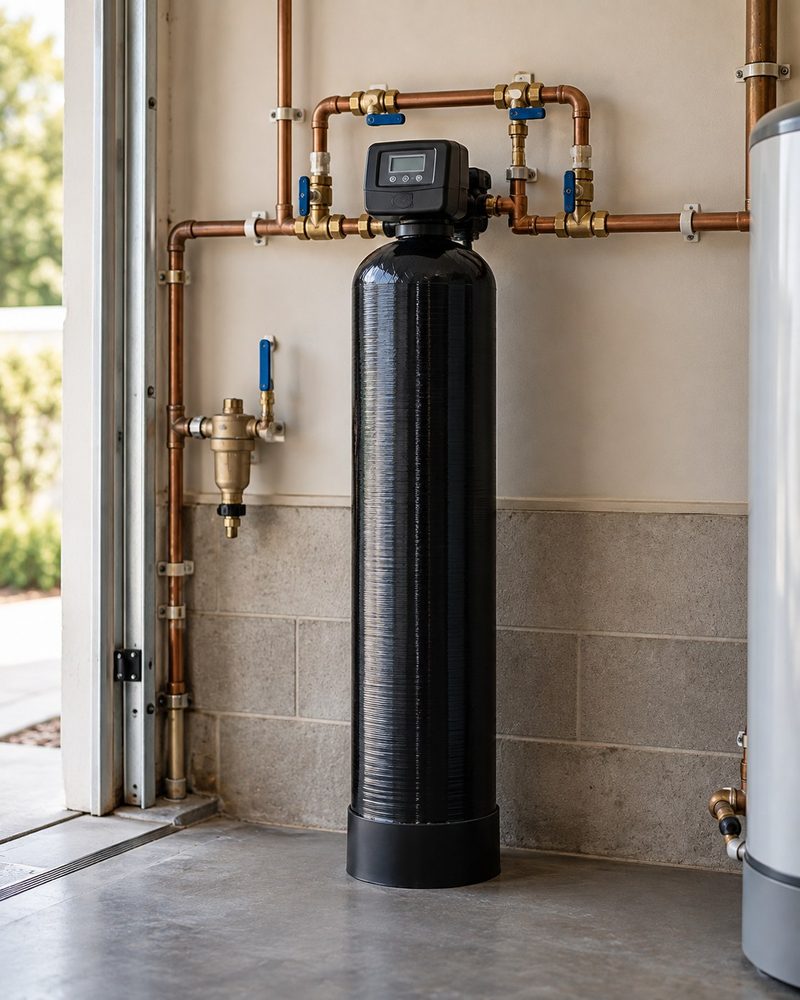
A big house with six bathrooms, where the only complaint is the chlorine taste. That house may need Cahaba Whole Home Essential at XL Estate Flow. It really does move a lot of water at once. Several showers can run alongside the laundry and the dishwasher, so the size has to be large. But the treatment goal is narrow, so Essential is the right level and the budget goes into flow capacity, where this house will actually use it. Cahaba Whole Home Essential ‑ XL
A small house with two bathrooms, where the owner wants everything: filtered water at every tap, softer water, our best drinking-water system, and UV. That house may need Cahaba Whole Home Signature at S Standard Flow. The flow demand is modest. The house creates a peak that S Standard Flow carries comfortably. But the treatment list is the long one, so the level goes all the way up while the size stays where the plumbing puts it. Cahaba Whole Home Signature ‑ S
Both builds are real, and both are priced the same way as every other cell in the grid: Quoted after sizing.
A larger system is the right system exactly when your home's flow demand calls for it.
Cahaba Water Co. — how we size
A size is an answer to a plumbing question.
Everything we measure or count before we pick a size.
These are the inputs. Some we measure on site and some we count. The ones that decide the size come from the plumbing itself.
- The service line, the pipe that brings water in from the street
- The number of bathrooms, and the fixture count
- Showers that can run at the same time
- Multiple showerheads or body sprays
- Large soaking tubs
- Laundry and dishwasher demand
- Other fixtures that move a lot of water
- Static pressure, measured at the house
- Dynamic pressure, measured while water is moving
- Peak GPM, which is gallons per minute at the busiest moment
- The flow the treatment media needs to work
- How much water the valve can pass
- The backwash rinse that cleans the media
We size whole-home systems from actual water demand. Square footage, home value, ZIP code and the number of people in the house give useful context, and the measurements decide it. Two homes of the same square footage can have completely different peak demand, depending on the service line, the fixtures and the pressure at the meter. Your size comes from the readings we take at your house.
What is documented, and where the claim stops
The inputs above, in full, before you agree to anything
The size we arrive at, and the readings that produced it
Your whole-home price, quoted once the house is measured and confirmed before anything is scheduled, because the price follows the build and the build follows the measurements
Flow breakpoints for S, M, L or XL stay with the sizing visit until those numbers are locked. A number we would have to correct later is worse than no number at all
The method itself is published too. Carbon capacity follows your peak flow, softening follows your measured hardness, and boosting follows a pressure test. See how we size systems.
Drinking water is its own choice, at its own published price. Drinking water
Four under-sink systems, each with a published price, each sold on its own.
Each one installs at a single tap, carries a fixed installed price, and stands on its own. Take one by itself, or pair it with a whole-home system at any treatment level and any size.
The four drinking-water systems, side by side
Cahaba Pure 50
ESSENTIAL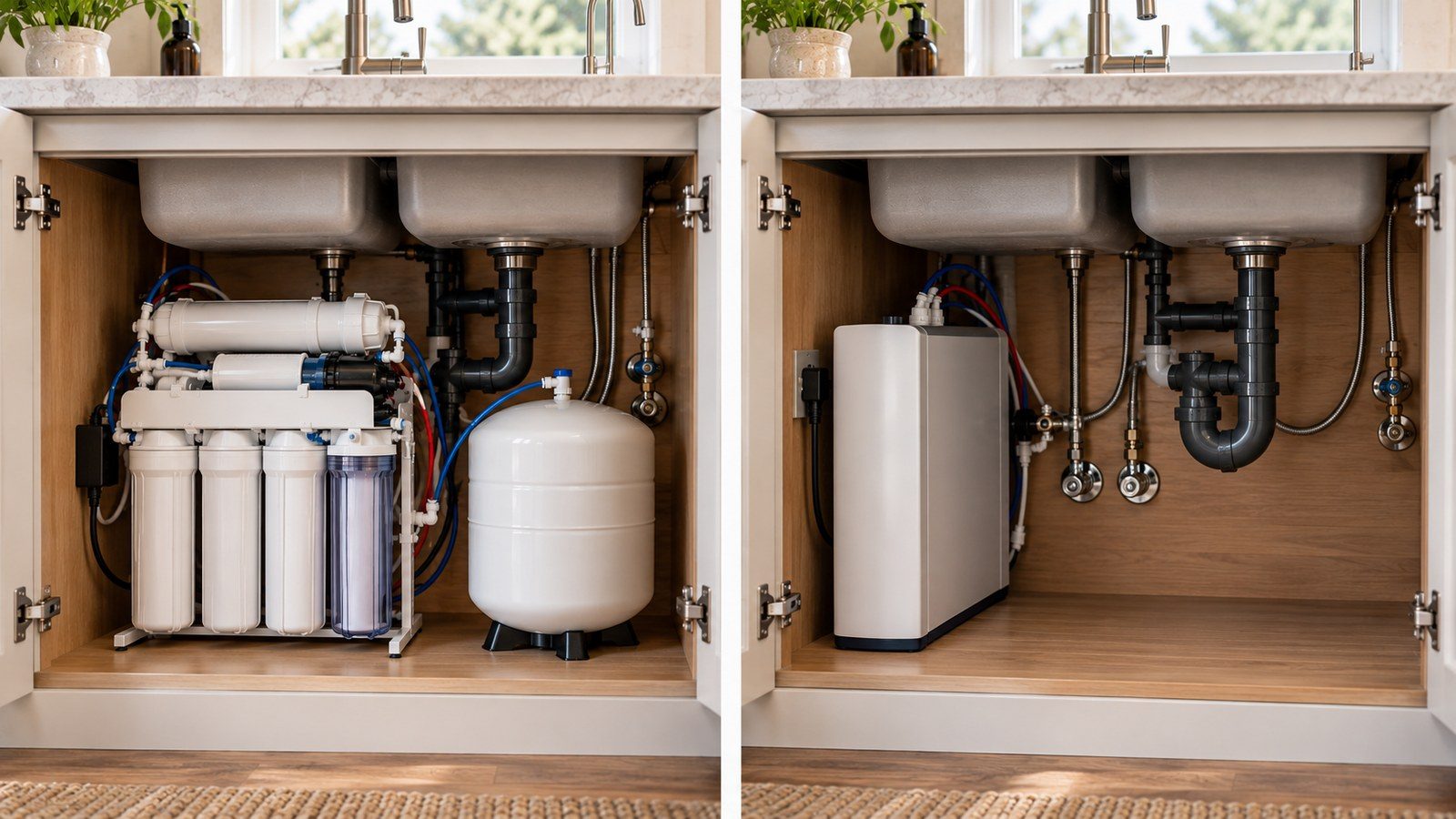
Reverse osmosis drinking water at one tap, at our lowest installed price.
For homeowners who mainly want better drinking water, with normal household use and enough incoming pressure to run it.
IAPMO R&T certifies this configuration to NSF/ANSI 58 and CSA B483.1, including PFOA and PFOS reduction.
Cahaba Performance 75
PERFORMANCEMore water per day, with boosted RO performance.
For homes that want more production, or where the pressure coming in needs support.
The manufacturer identifies the membrane and the storage tank as NSF certified. We do not claim complete-system certification for this platform.
Cahaba Signature 75
SIGNATUREOur premium traditional-tank RO system.
For homeowners who want the top traditional-tank RO platform Cahaba offers.
The storage tank is identified as NSF certified, not the complete system. We do not claim complete-system certification for this platform.
Cahaba Slim 800
TANKLESSHigh-output RO with no storage tank under the sink.
Choose Slim 800 for cabinet space and direct-flow production. It is an alternative to the traditional-tank systems, at the same installed price as Cahaba Signature 75.
We publish no certification claim for this platform.
What is documented, and where the claim stops
A higher rung means a different platform at a different price, described in the words its own documentation supports
Certification is stated per product, at the level it is actually documented: complete system, component, or not published
A higher production figure does not mean greater contaminant reduction
More stages does not mean better treatment
Tankless does not mean cleaner or purer water
A claim documented for one product is never repeated for another
Manufacturer detail, without pricing attached, is published on the equipment page.
Questions we get about this.
Does a bigger house need a higher treatment level?
Is Cahaba Whole Home Signature better than Cahaba Whole Home Essential?
What do S, M, L and XL mean?
Do you size a system from square footage?
What does a whole-home system cost?
Is the biggest system the best one?
Both decisions, in one visit
We measure the house and test what testing decides. Then we give you the treatment level and the size separately, each with the readings behind it, and we confirm the final price before scheduling.