 Cahaba Water Co.
Estate Flow is a size. XL, the largest of four.
XL is the largest of our four system sizes. It answers how much water your house moves at once.
XL answers one question. How much water does this house have to move at once? What your water needs treated is the second question, answered on its own terms and quoted in the same visit. Every treatment level is available at XL.
an answer about flow
chosen on its own
never square footage
Estate now names a size. That makes the quote easier to read.
What the word Estate means on this site now.
If you came here looking for an Estate system, you have the right page. What the word names has changed shape. The change is an improvement, and it is worth two paragraphs.
Estate Flow is the name of XL, the largest of our four sizes. A size is half of a Cahaba whole-home build. The other half is the treatment level, and you choose that on its own terms. Estate is a size, not a tier — the one distinction this page exists to draw.
The old arrangement had one dial. You moved up it and everything moved together. Bigger house, bigger equipment, broader treatment, bigger invoice. It is a tidy story, and an easy one to sell.
Two dials describe more houses. A six-bath home that wants the chlorine taste gone needs plenty of flow and a short list of things treated at the same time. One dial cannot say that. Two can.
Three treatment levels, four sizes, and how the two decisions meet: it is all set out on size and treatment level.
XL is the largest of four. All four are the same kind of thing.
These are sizes. Each one names a flow capacity.
Each one says how much water the equipment is built to pass at once. That is the whole of what a size means here: a flow capacity, matched to a house. A size does not rank your house.
A finished build is named for both decisions at once. Cahaba Whole Home Complete at Enhanced Flow is written Cahaba Whole Home Complete‑M. An XL build works the same way: Cahaba Whole Home Essential‑XL, Cahaba Whole Home Complete‑XL, Cahaba Whole Home Signature‑XL.
Every input that set your size, before you agree to anything
The size we arrived at, and the readings behind it
The final price, confirmed with you before we schedule the work
No flow breakpoints for S, M, L or XL — those figures are still being locked, and your own readings are what set your build
No whole-home price over the phone — the price follows the build, and the build follows the measurements taken at your house
XL described as the top of a ladder — it is the widest pipe we build, matched to the busiest houses
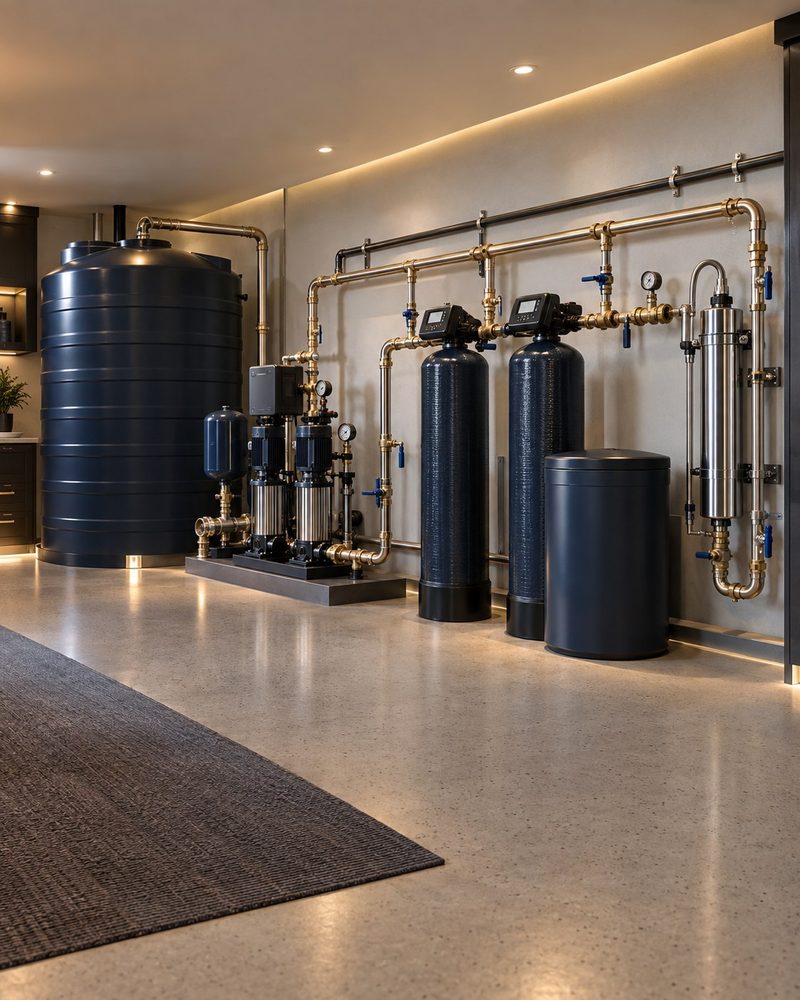
Cahaba Whole Home Essential at XL is a real build. We install them.
A big house does not have to mean broad treatment.
This is the case the old page had trouble describing, so it is worth stating plainly. Cahaba Whole Home Essential‑XL is a valid build Whole home.
Picture the house. Six baths, several in use on a weekday morning. A soaking tub. A laundry room that runs while the dishwasher runs. The pipe from the street is generous and the fixtures are real. That house needs flow, and XL is the answer to it.
Now ask the second question. What does the owner want treated? For a great many Birmingham homes the answer is chlorine taste and odor at every tap. Then the treatment level is Cahaba Whole Home Essential, the quote stops there, and the budget goes into flow, where this house actually needs it.
Big house, short treatment list. Both true at once, on purpose.
It runs the other way too. Picture a small two-bathroom house where the owner wants everything. Filtered water at every tap, softer water, UV, and a Cahaba under-sink drinking-water system Drinking water. That house may be a Cahaba Whole Home Signature at S Standard Flow: a modest amount of water at once, with the longest list of things treated. Sizing it up would add cost and leave the treatment exactly where it already is.
Both examples sit in a grid, and that grid is worked through on size and treatment level. Every corner of it is a build we quote.
A size is an answer to a plumbing question.
Every input below is measured or counted at your house.
XL comes from readings taken at the house. Below are the inputs. Some we measure on site and some we count. The ones that matter most are the ones an address cannot tell you.
- How wide the pipe from the street is
- How many bathrooms you have
- Whether showers run at the same time
- Showers with more than one head, or body sprays
- Big soaking tubs
- How much laundry runs
- How often the dishwasher runs
- Any other fixture that pulls a lot of water
- Static pressure, measured with nothing running
- Dynamic pressure, measured while water is running
- Your peak GPM, measured or estimated
- How fast water may pass the media, the material in the tank that does the treating
- How much water the valve can pass
- How much flow a backwash needs, the cycle where the tank rinses itself clean
Fixture count
We list every fixture and appliance on the house line. Then we ask which of them really run at the same time.
Pressure test
First the pressure with nothing running. Then the pressure while several fixtures run at once. The second reading is the one that decides things.
Pipe from the street
How wide the pipe from the street is, and what shape it is in. It can cap what you get, whatever we install after it.
Size, then treatment
We set the size against how fast water may pass the media, what the valve can pass, and what a backwash needs. The treatment level is decided on its own.
The method itself is on how we size systems. How much carbon you need follows your peak flow. Softening follows a hardness test. A booster pump follows a pressure test.
The right size sits between two errors. Neither one is a verdict on the house.
Too small and too big both cost you. Only one of them is obvious.
Undersized shows up exactly when the house is busiest. Pressure drops as fixtures come on together. The media is asked to treat water faster than it can. You feel it as a shower that goes weak when the laundry starts.
Oversized is quieter, and it still costs you. More media than the water needs. A larger tank to buy and to find room for. More water used every time it rinses itself clean. The water at the tap comes out the same.
XL is correct when measured peak demand calls for it, and only then
If your readings land on S, M or L, that is what we quote
We do not size up because of a ZIP code or a square-footage figure
A booster pump standing in for a system that is sized too small
XL sold as an upgrade from L — it is a different answer to a different house
Booster pumps and drinking-water storage are separate decisions with their own assessment, taken once the size is set. See water resilience and storage.
Drinking water is its own decision.
You choose your drinking-water system on its own merits. Drinking water
The under-sink systems install at one tap and carry a fixed installed price. Cahaba Pure 50, Cahaba Performance 75, Cahaba Signature 75 and Cahaba Slim 800 are each chosen on their own merits, at any house size. Many customers start with one on its own, with no whole-home system at all.
We publish drinking-water prices on the drinking-water page, along with the certification wording each product's own documentation supports. Manufacturer detail sits separately on the equipment page.
Questions we get about this.
Is Estate a product tier?
Can I have Cahaba Whole Home Essential at XL Estate Flow?
What is the GPM rating of an XL Estate Flow system?
Does a large house automatically need XL Estate Flow?
What does an XL Estate Flow system cost?
Both decisions, in one visit
We measure the house and test what needs testing. Then we give you the size and the treatment level separately, with the readings behind each one, and a price we confirm before we schedule.