 Cahaba Water Co.
Do you actually need a water softener in Birmingham?
It depends on your tap, not on the metro. Central Alabama Water publishes hardness from 2.2 to 13.1 grains per gallon — here is what that spread means for your house.
The short version
- Central Alabama Water publishes a total hardness range of 38–224 mg/L, or roughly 2.2–13.1 grains per gallon.
- That span crosses four of the five classification bands — slightly hard at the bottom, very hard at the top. One metro-wide number cannot describe it.
- Under ~3 gpg a softener buys you very little. Over ~7 gpg it earns its cost. Which one you are is a measurable fact, and the measurement is free.
- Birmingham's Langelier Saturation Index is negative across the system — by that measure, the water is not scale-forming.
- On a different utility? Trussville publishes 8.9 gpg system-wide, Pelham 4.4 and 11.9, Alabaster 11.4 / 5.0 / 5.6. Different utility, different answer.
We sell water softeners, so read the rest of this with that on the table. The figures below are the utility's own, and they point somewhere more specific than a yes or a no for the whole metro.
A water softener isn't automatic in Birmingham.
Hardness varies by water source and by where you sit in the system, so we test your home's water before recommending one. If the number comes back low, we'll tell you. If the hardness level and your goals justify softening, we'll size the system accordingly.
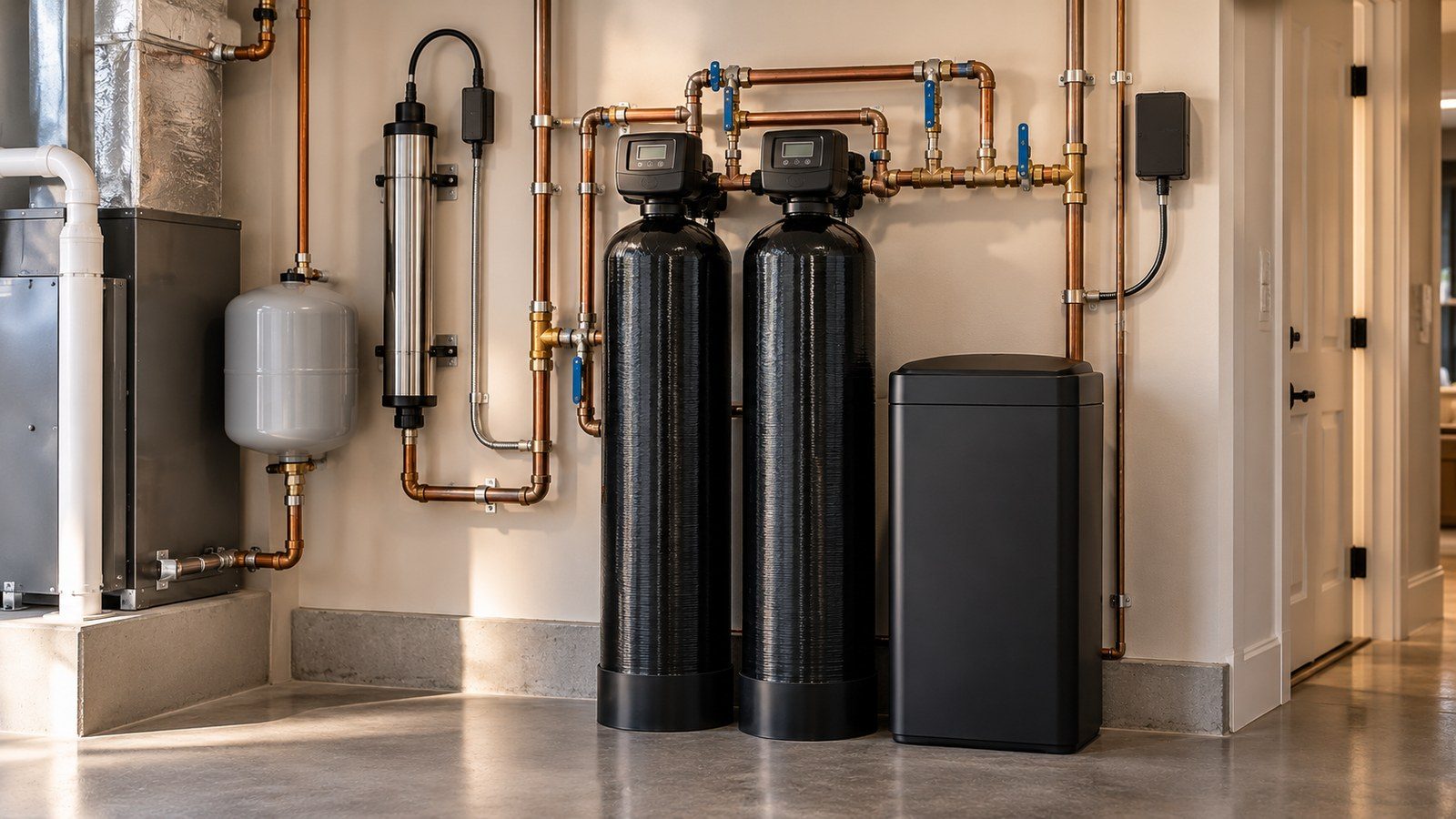
The range, and why one number can't cover it
Water hardness is measured in grains per gallon. Central Alabama Water (formerly Birmingham Water Works) publishes its figures annually, and the 2026 report — covering 2025 monitoring — gives a system-wide total hardness range of 38 to 224 mg/L.
Divide by 17.1 to convert, and that's 2.2 to 13.1 grains per gallon depending on where in the system you are. That is a spread of nearly six to one, and it crosses four of the five standard classification bands.
| Classification | Grains per gallon | Where that is |
|---|---|---|
| Soft | 0 – 1 | Parts of the Pacific Northwest, New England |
| Slightly hard | 1 – 3.5 | Birmingham's low end — 2.2 gpg |
| Moderately hard | 3.5 – 7 | Inside Birmingham's published range |
| Hard | 7 – 10.5 | Inside Birmingham's published range |
| Very hard | 10.5+ | Birmingham's high end — 13.1 gpg. Also Phoenix, Las Vegas, San Antonio |
The residential softener industry was built on that bottom row. In Phoenix, at 15 to 25 grains per gallon, scale is visible, fast and expensive — a water heater element furs up in a couple of years and you can watch it happen. A softener there pays for itself in maintenance avoided.
Birmingham's high end lands in the same classification band as those cities, at lower numbers. Its low end sits four bands away, where softening has almost nothing to work on. Both ends are published by the same utility in the same report, which is the whole reason this article exists: the range tells you what the system can deliver, and a test tells you what your house actually gets.
The second number worth knowing
In the secondary standards table of the same report is something called the Langelier Saturation Index. It's a calculated value that predicts whether water will deposit scale or dissolve it.
Positive LSI means scale-forming. Negative means the opposite.
This matters because the softener sales pitch in almost every market is built on scale damage: your pipes are furring up, your water heater is dying, your fixtures are being destroyed. In a genuinely hard, positive-LSI market, that argument has real force.
Here the index stays negative even at the hard end of the range, which puts scale damage on thinner ground than it would be in a positive-LSI market. Where hardness is genuinely high, softening still earns its place on soap performance, spotting and appliance life. That is the case we'll make for it, and the case we'll size it on.
About the numbers you'll find online
Search "Birmingham water hardness" and you'll get a spread of figures: 5.4, 8.2, 8.5, 9.2, and one site confidently reporting 15.2 grains per gallon under the heading "extremely hard."
Every one of those is a single number standing in for a system that publishes a range from 2.2 to 13.1. Some of them land inside it. The 15.2 figure sits above the measured system maximum in the utility's own report, and several aggregators have folded in results for Birmingham, England, which describe a different city on a different continent.
Check any hardness figure you're quoted against the utility's own annual report, then against a test at your own tap. It takes two minutes, it's free, and it's the same thing we do.
If your bill comes from somebody else, the numbers change
Everything above this line describes Central Alabama Water. In three of the places we work the published figures are different, and in two of them the answer depends on which source serves your street.
Central Alabama Water draws from rivers and lakes — the Cahaba, the Little Cahaba, Lake Purdy, Inland Lake and the Black Warrior. Several sources feeding one large distribution system is why its published hardness arrives as a wide range rather than a single figure.
Groundwater behaves differently. North-central Alabama sits on limestone and dolomite, and water held in those aquifers dissolves calcium and magnesium out of the stone it rests in. That is the mechanism, and it is why a well-fed utility tends to publish one steady high number instead of a range.
Here is what these utilities report in their own annual water quality reports:
| System | Where the water comes from | Published total hardness | In grains |
|---|---|---|---|
| Central Alabama Water | Rivers and lakes | 38–224 mg/L | 2.2–13.1 gpg |
| Trussville Gas & Water | Eight wells | 152 mg/L | 8.9 gpg |
| Pelham Water Works | Five wells, plus purchased river water | 75 and 204 mg/L | 4.4 and 11.9 gpg |
| Alabaster Water Board | Three wells, plus three purchased supplies | 195 / 86 / 95 mg/L | 11.4 / 5.0 / 5.6 gpg |
Read the Pelham and Alabaster rows carefully, because they are doing something the Birmingham row isn't. Those utilities run more than one source and report each one separately. Alabaster's wells come in at 11.4 grains. The Coosa River water it buys comes in at 5.0. Both numbers are true at the same time, for different houses, and the report does not tell you which one arrives at yours.
So for those two systems we ask the utility which source serves your address before quoting anything. Until that's answered, a hardness figure for a Pelham address is a guess.
Trussville is simpler. Eight wells, one answer, 8.9 grains — above the threshold in the next section, every day, for everybody on that system. There is no internal range to land on the low side of, which makes it one of the clearest softening cases in the metro.
Trussville gets something back for it, and it is worth knowing. Its trihalomethanes — the byproducts that form when chlorine meets organic matter — run from non-detect to 7.5 parts per billion. Central Alabama Water's samples run 11.4 to 26.0. Both sit well inside the 80 ppb federal standard. Groundwater carries almost nothing for chlorine to react with, so Trussville trades hardness for some of the lowest disinfection byproducts in the metro. Neither water is the better water. They are different problems, and they take different equipment.
Two systems we serve are not on this table. Bessemer's report is not published anywhere we can reach, so we'll print a figure for it once we've read the report itself. And if you are on a private well, none of this applies to you at all — there is no utility, no annual report, and no published range. There is only a lab test. That is a different article.
When a softener genuinely earns its place
There are real cases, and if yours is one of them we'll say so.
- You test at the upper end. Above about 7 grains per gallon, softening delivers noticeable improvements in soap performance, spotting and appliance life. A good part of Central Alabama Water's published range sits above that line.
- You have visible scale. On glass shower doors, kettle elements, fixtures. Trust what you can see over any published range.
- You're protecting something specific. A tankless water heater is more sensitive to scale than a tank unit, and manufacturers sometimes make warranty terms conditional on water hardness.
- Soap and detergent performance genuinely bothers you. This is a preference, and a legitimate one. Softened water lathers differently and many people prefer it.
When it doesn't
- You test under about 3 grains. Most of the benefit simply isn't there to capture, and the low end of the published range reaches down to 2.2.
- Your actual complaint is taste or smell. That's carbon and RO. Softening will not improve the taste of your water — if anything, some people find softened water tastes slightly flat.
- You'd rather not add sodium. Ion exchange works by swapping hardness minerals for sodium. The amount is modest and depends on your hardness, but it's real, and worth knowing if you're managing intake.
- Your water hasn't been measured yet. This is the big one, and it's the easiest to fix. With a range this wide, a number comes first and the decision follows it.
Test before you buy — it costs almost nothing
A hardness test strip costs a few dollars. It takes thirty seconds: dip it in cold tap water, wait, read the color.
We'll mail you one free, because it's cheaper for us than a truck roll and because it's the right way to have this conversation. Text us the result and we'll tell you where you land:
| Your result | What we'll tell you |
|---|---|
| Under 3 gpg | Softening has little to work on. Put the money into carbon or RO instead. |
| 3 – 7 gpg | Optional. A preference, not a need. We'll explain the trade and let you decide. |
| 7 – 10.5 gpg | Genuinely worth it. This is where softening earns its cost. |
| Over 10.5 gpg | Very hard. Softening does real work here, and we'll size it to your hardness and your household. |
Ours arrives in the mail. You read it yourself, on your own schedule, and you text us a number. If that number says softening isn't worth it in your house, that's the answer you get.
One more thing
If you're on a private well, none of this applies. Wells are unregulated and untested, genuinely hard water is common in this region, and iron and sulfur are real possibilities. That's a different product conversation, and it starts with a proper lab test rather than a phone call.
And if you're in Trussville, Pelham or Alabaster, you're on a different utility with its own sources and its own published report. The figures above are Central Alabama Water's. Start from your own utility's report, then from a test at your tap.
Get a free hardness test
Mailed to you, read by you. Text us the result and we'll tell you where your house falls in the range and whether softening is worth it.
Request a test stripQuestions we get about this
How hard is Birmingham Alabama water?
Do I need a water softener in Birmingham?
Is Birmingham water extremely hard?
Does a water softener improve the taste of water?
Sources
- Central Alabama Water. 2026 Annual Water Quality Report (2025 monitoring data) — total hardness, trihalomethanes and Langelier Saturation Index.
- Trussville Gas & Water, Pelham Water Works and Alabaster Water Board. Consumer Confidence Reports on file — hardness by source, trihalomethanes.
- US Geological Survey. Hardness of water — classification thresholds.
- Water Quality Association. Technical resources on ion exchange softening.