 Cahaba Water Co.
Backflow prevention for food service: carbonators, and why the health department cares
Carbonated water backing into copper pipe makes carbonic acid, and carbonic acid dissolves copper into the next drink you pour. That is the whole reason this device exists.
The short version
- CO2 backing out of a carbonator into copper pipe forms carbonic acid, which dissolves copper into the drink.
- Alabama's ADPH manual cites ASSE #1032 for carbonators, and says continuous-pressure coffee-urn units are “not approved for soda carbonators.”
- Substitution is the common failure — a similar-looking approved device fitted to the wrong appliance.
- PROFESSIONAL CONFIRMATION REQUIRED. Device selection belongs to a licensed plumbing contractor and your authority having jurisdiction. Not to us.
If you serve fountain drinks, there is a device on your water line that most operators have never looked at, cannot name, and would fail an inspection without. It is not a filter and it does not improve your water. It exists to stop something specific and genuinely dangerous from happening backwards.
This one is worth understanding rather than delegating blindly, because the failure mode is a poisoning, and because the fix is cheap relative to what it prevents.
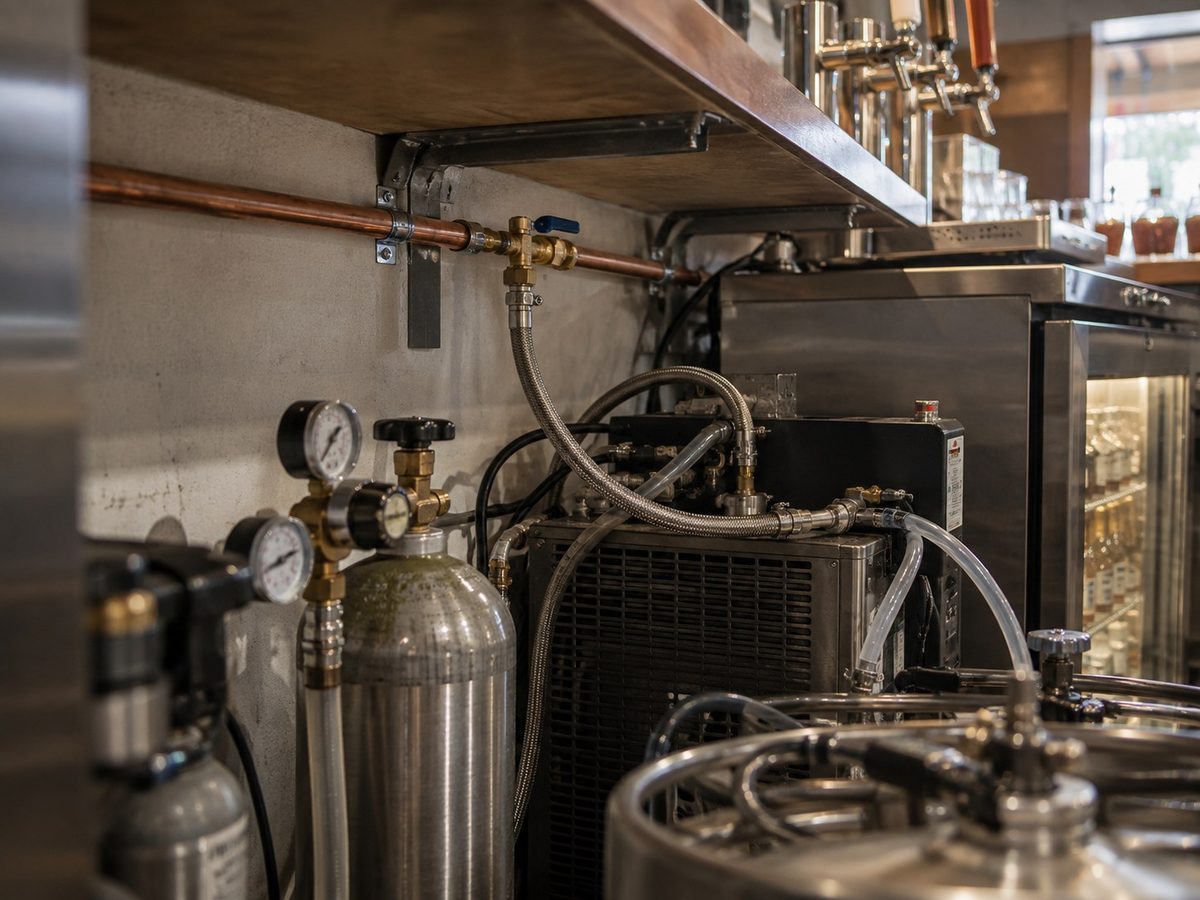
What actually goes wrong
The Alabama Department of Public Health's own cross-connection control training manual describes it in one sentence, and it is worth reading in the original:
"The ball check is an extra precaution to prevent carbon dioxide (CO2) from backflowing (via backpressure) out of a soda carbonator and into any copper supply lines. The CO2 gas reacts with water to form carbonic acid, which in turn will dissolve the copper lines and thus create possible copper toxicities in those ingesting the water."
Alabama Department of Public Health, BETC Plumbing Information Manual, Cross-Connection Control Module 3
Unpack that. A carbonator pushes CO2 into water under pressure. If that carbonated water can travel backwards into the building's supply piping, and that piping is copper, it makes carbonic acid against the inside of the pipe. Carbonic acid dissolves copper. The copper then goes into the next drink somebody pours.
This is not theoretical. Copper poisoning from carbonated beverage systems is a documented food-safety event, and it is the reason a specific device class exists at all.
Why the health department cares more than you expect
Most water quality issues in a restaurant are quality-of-product questions. This one is a public health question with a named mechanism and a known casualty pattern, which puts it in a different category entirely. It is cheap to check and unambiguous to find, so it gets checked.
It is also the kind of finding that travels. A carbonator installed by a soda vendor, a line moved by a contractor during a remodel, a device that was correct in 2019 and was swapped for a cheaper one in 2023 by somebody who did not know the difference — none of those are things the operator did wrong, and all of them land on the operator.
The part that catches people: not all of these are the same
This is the detail worth taking away from this article. Backflow devices are approved for specific hazard levels and specific pressure conditions, and a device that is perfectly correct on one appliance is explicitly wrong on another.
The same ADPH manual, describing a device class approved for continuous pressure on coffee and tea urns and ice makers, adds a parenthetical:
"Units that are approved for continuous pressure can be used in supply lines for low water volume needs such as coffee and tea urns or ice makers. (Not approved for soda carbonators.)"
ADPH, Cross-Connection Control Module 3
The carbonator device gets its own listing in that manual, described as internally similar but with an added ball check valve, and cited to ASSE standard #1032. The coffee-urn device is cited to a different standard.
So the practical failure is substitution. Somebody needs a backflow preventer, has one on the truck that looks right and is genuinely approved for a similar-sounding application, and fits it. The drink line now has a device on it that Alabama's own training material says is not approved for that use. Nothing looks wrong. Nothing tastes wrong. It is a finding waiting to happen, and in the worst case it is the mechanism above.
What we will not tell you on a web page
We are not going to specify a device for your building, and you should be suspicious of anyone who does without seeing it. ADPH says why, in the manual's own words:
"The specific use and installation of a backflow prevention assembly or device must be clarified by the manufacturer and comply with the plumbing codes governing the jurisdiction in which the unit is installed."
ADPH, Cross-Connection Control Module 3
PROFESSIONAL CONFIRMATION REQUIRED. Device selection, installation and testing on your premises is settled by a licensed plumbing contractor, by the plumbing code as adopted in your jurisdiction, and by the authority having jurisdiction — which for cross-connection control usually means your water utility as well as the health department. Not by us, and not by an article.
What to actually do this week
1. Find it and photograph it
It sits on the water supply to the carbonator, usually within a few feet. Photograph the label, including the ASSE number and the model. You now have more documentation than most operators in this metro.
2. Check that it is accessible
ADPH's manual states that backflow devices "must be installed so they are accessible for inspection, service and repair." Buried behind a fixed panel or boxed in during a remodel is itself a problem.
3. Check the vent is not plugged or piped somewhere clever
The atmospheric vent is the part that does the work in a fault. It needs to be able to discharge to air. Anyone who has routed it neatly into a drain has disabled the device.
4. Ask who tests it and when
If the answer is nobody, that is the finding you are going to get. Ask your plumbing contractor and your utility what the testing interval is where you are.
5. Ask the same questions after any remodel
This is where most problems are introduced — not at the original installation, but the second or third time the line was touched.
Where we fit, and where we do not
We install water treatment. Backflow prevention is a plumbing and cross-connection-control matter and it is not our certification to hold. When we work in a kitchen and see something on the drink line that does not look right, we say so and tell you to get a licensed plumber on it — and that is the whole of our involvement.
We mention it here because it comes up constantly in the same conversation as filtration, because vendors sometimes blur the two, and because a filter cartridge on a drink line is not backflow protection no matter how it is described on an invoice. Those are different devices doing different jobs, and only one of them is about keeping copper out of a customer.
We install treatment, not backflow assemblies
If we are in your kitchen and something on the drink line looks wrong, we will tell you and point you to a licensed plumber. Here is what we do handle.
Commercial water treatmentQuestions we get about this
Why do carbonated beverage dispensers need a backflow preventer?
What backflow preventer does a soda carbonator require in Alabama?
Can I use the same backflow preventer on a coffee urn and a carbonator?
Does a water filter count as backflow protection?
Who is responsible for backflow prevention in a restaurant?
Sources
- Alabama Department of Public Health. BETC Plumbing Information Manual — Plumbing & Cross-Connection Control, Module 3. All quoted material above. Archived in
sources/regulatory/. - ASSE International. Product standards index — the standard numbers referenced by that manual.