 Cahaba Water Co.
Reverse osmosis, explained without the sales pitch
How it works, what it genuinely removes, what it doesn't, and the questions that separate a well-specified system from a marked-up one.
The short version
- RO pushes water through a semi-permeable membrane that rejects most dissolved contaminants.
- The standard that matters is NSF/ANSI 58 — and a certified complete system is not the same as a system built from certified parts.
- A specific contaminant claim has to appear on that product's listing. Baseline NSF 58 covers TDS reduction, not everything.
- It's the right tool for drinking water. It is not a whole-home solution and can't treat your shower.
Reverse osmosis is the most oversold and under-explained product in residential water treatment. It's also genuinely excellent at what it does. Both of those things are true, and the gap between them is where people get taken advantage of.
How it actually works
Osmosis is the natural tendency of water to move across a semi-permeable membrane from a less concentrated solution to a more concentrated one. Reverse osmosis does what the name says: it applies pressure to push water the other way, through the membrane, leaving dissolved contaminants behind.
The membrane's pores are extraordinarily small — small enough to pass water molecules while rejecting the large majority of dissolved salts, metals and many organic compounds. What's rejected goes down the drain. What passes through is your drinking water.
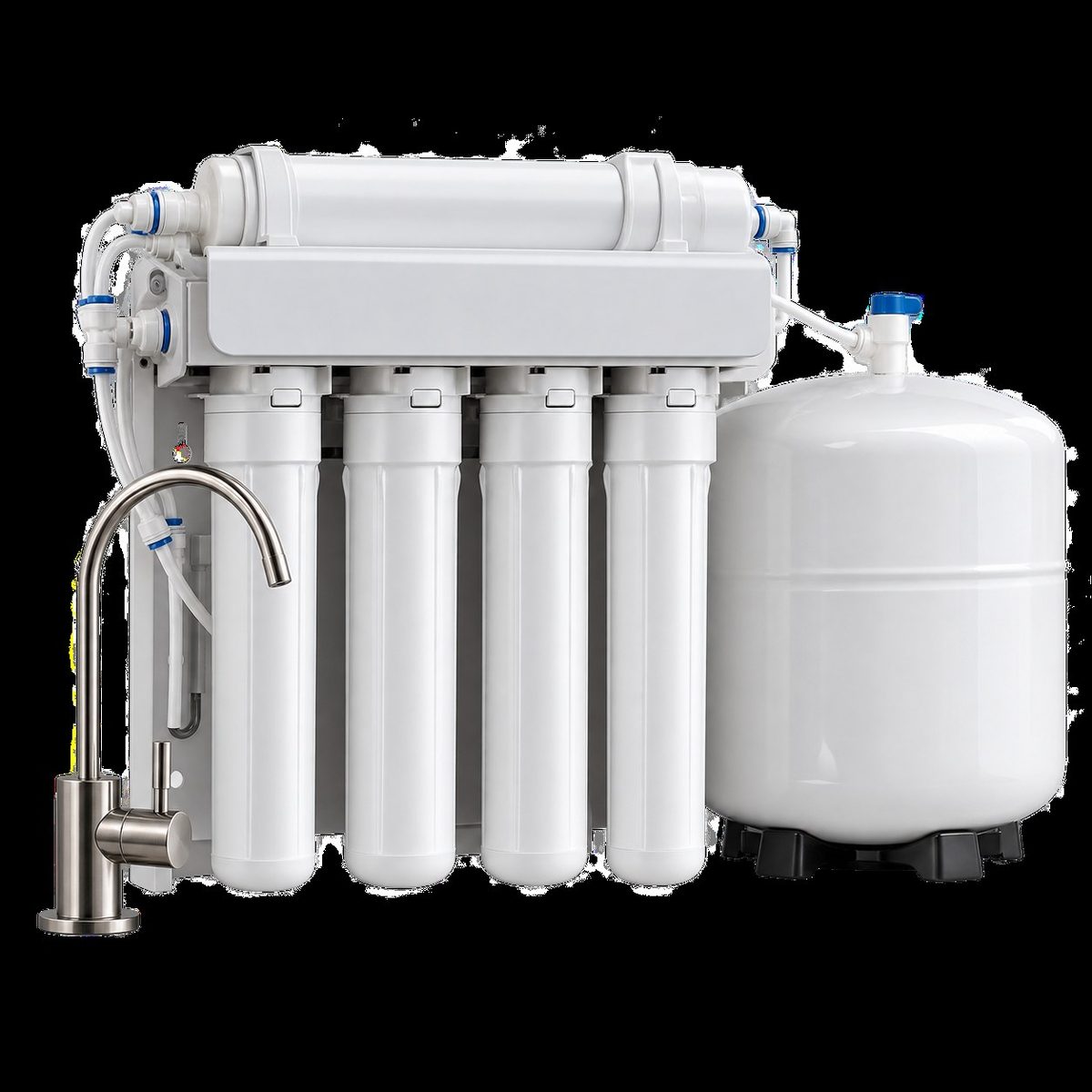
A typical four-stage residential system runs like this:
- Sediment prefilter — catches particulates that would otherwise foul the membrane.
- Carbon prefilter — removes chlorine, which is important because chlorine degrades most RO membranes. This stage protects the expensive part.
- RO membrane — the actual separation.
- Carbon postfilter — final polish on taste before the water reaches the faucet.
Treated water collects in a small pressurized storage tank, because production is slow — a 50 GPD system makes roughly 50 gallons across a full day, not on demand. The tank is what lets you fill a glass instantly.
The certification question, which is where the industry gets slippery
This is the part worth reading twice.
NSF/ANSI 58 is the standard covering point-of-use reverse osmosis systems. When someone says a system is "NSF certified," the useful follow-up questions are: certified to which standard, and certified as what?
Four different things get described as "certified," and they are not equivalent:
| What it means | Strength |
|---|---|
| Certified complete system — the whole assembly is listed by an accredited certifier against a specific standard | Strongest |
| Certified component — one part is certified, e.g. a fitting for lead-free content | Says nothing about the assembled system |
| Manufacturer performance claim — the maker's own tested data, not third-party verified | Can be legitimate, but is a different thing |
| General capability — "RO reduces dissolved solids" | True of the technology, not a claim about a product |
And baseline certification isn't a blanket
Here's the second trap. NSF/ANSI 58 certification at baseline covers total dissolved solids reduction. Additional contaminant claims — lead, arsenic, nitrate, PFOA and PFOS — are separate claims that must appear on that specific product's listing.
So "NSF 58 certified" followed by a list of contaminants the salesperson recites is not, by itself, evidence of anything. The EPA says this directly in its guidance on identifying filters certified to reduce PFAS: check the certifier's listing to see whether the product treats the specific contaminant you care about.
Ask for the certifier's listing number. Any legitimate supplier can produce it in seconds, and you can look it up yourself in NSF, WQA, IAPMO, UL or CSA's public database. If nobody can point you at a listing, treat the claim as marketing.
What RO does and doesn't do
Does well
- Dissolved solids — the core function.
- Taste and odor, including the seasonal musty geosmin that affects Birmingham each spring. The low flow rate gives generous contact time through the carbon stages.
- Specific contaminants it's certified for — which, depending on the product, can include lead, arsenic, nitrate, and PFOA/PFOS.
Doesn't
- Treat your whole house. It's point-of-use. Your shower, laundry and bathroom taps are untouched. See why that distinction matters.
- Soften water. It doesn't address hardness at the fixtures where hardness is a nuisance.
- Produce water quickly. 50 GPD means 50 gallons per day, not per hour.
- Run without waste. RO sends some water to drain. Ratios vary, and higher-efficiency membranes have improved this considerably, but it isn't zero.
The remineralization question
RO produces very low-mineral water. Some people find it tastes flat — there's genuinely less in it.
A remineralization stage adds a small controlled amount of mineral content back, which most people find improves the taste. It's worth knowing this is available, and worth knowing it's a taste preference rather than a health necessity. Anyone presenting remineralization as medically important is overselling.
It matters slightly more in Birmingham than in some markets, because the water is already moderately low in dissolved solids before treatment.
What to ask before you buy one
- Is the complete system certified, or just components?
- What's the certifier's listing number? Then look it up.
- Does that listing include the specific contaminant you care about?
- Who makes it? If the answer is a brand name that exists only on that installer's truck, your filter supply and service options are whatever they decide.
- Where do replacement filters come from, and what do they cost? A cheap system with proprietary annual cartridges is not cheap.
- Is there leak protection? A mechanical leak detector is inexpensive and sits under a cabinet you rarely open.
That last one gets skipped constantly. Under-sink equipment fails quietly, and the first sign is usually a warped cabinet floor.
Where we land
Our Pure 50 is $995 installed. It's a four-stage system, nominal 50 GPD, with an approximately 4-gallon metal storage tank and a standard chrome air-gap faucet. IAPMO R&T certifies this configuration to NSF/ANSI 58 and CSA B483.1, including PFOA and PFOS reduction. That comes from the manufacturer's performance data sheet, which names the model directly. We publish no microplastics claim for it - no listing we hold names them.
We also offer the Cahaba Performance 75 — nominal 75 GPD, five stages, with an integrated booster pump for homes where incoming feed pressure needs support. The manufacturer identifies that platform as certified to NSF/ANSI 58. That is a different certifier and a different listing from the Pure 50's, which is exactly why we print them separately and never move one onto the other. More production is not the same as more reduction.
If your problem is drinking water, this is the product. If your problem is chlorine in the shower, it isn't — and we'd rather tell you that before you buy.
Pure 50 — $995 installed
Four-stage reverse osmosis, nominal 50 GPD, installed in about ninety minutes. IAPMO R&T certifies this configuration to NSF/ANSI 58 and CSA B483.1, including PFOA and PFOS reduction. Published price, no sales visit.
See the systemQuestions we get about this
What does reverse osmosis remove?
Is NSF certified the same as certified for PFAS?
Does reverse osmosis treat the whole house?
Why does reverse osmosis water taste flat?
Sources
- NSF International. NSF standards for water treatment systems.
- US EPA. Identifying drinking water filters certified to reduce PFAS.
- Central Alabama Water (formerly Birmingham Water Works). 2026 Annual Water Quality Report.