 Cahaba Water Co.
The undersized filter problem: why your water pressure dropped after you bought a water system
It's the most common complaint in residential water treatment, and it's almost always the same mistake. It is also entirely avoidable — before you buy, not after.
The short version
- Carbon works by contact time. Too much flow through too little media and water channels straight through.
- Pressure drop shows up when several fixtures run at once — exactly when you notice.
- Sizing follows design peak flow, calculated from fixtures. Not square footage, not house value.
- A booster pump masking an undersized filter is the wrong fix, and it makes the channeling worse.
Somebody buys a whole-home filter. It's fine for a week. Then someone runs the dishwasher while a shower's going, and the shower pressure sags. Now there's a $3,000 system in the garage and a complaint about water pressure.
This is the single most common failure in residential water treatment, and it is essentially always the same root cause: the filter was sized to a price point rather than to the house.
What's actually happening
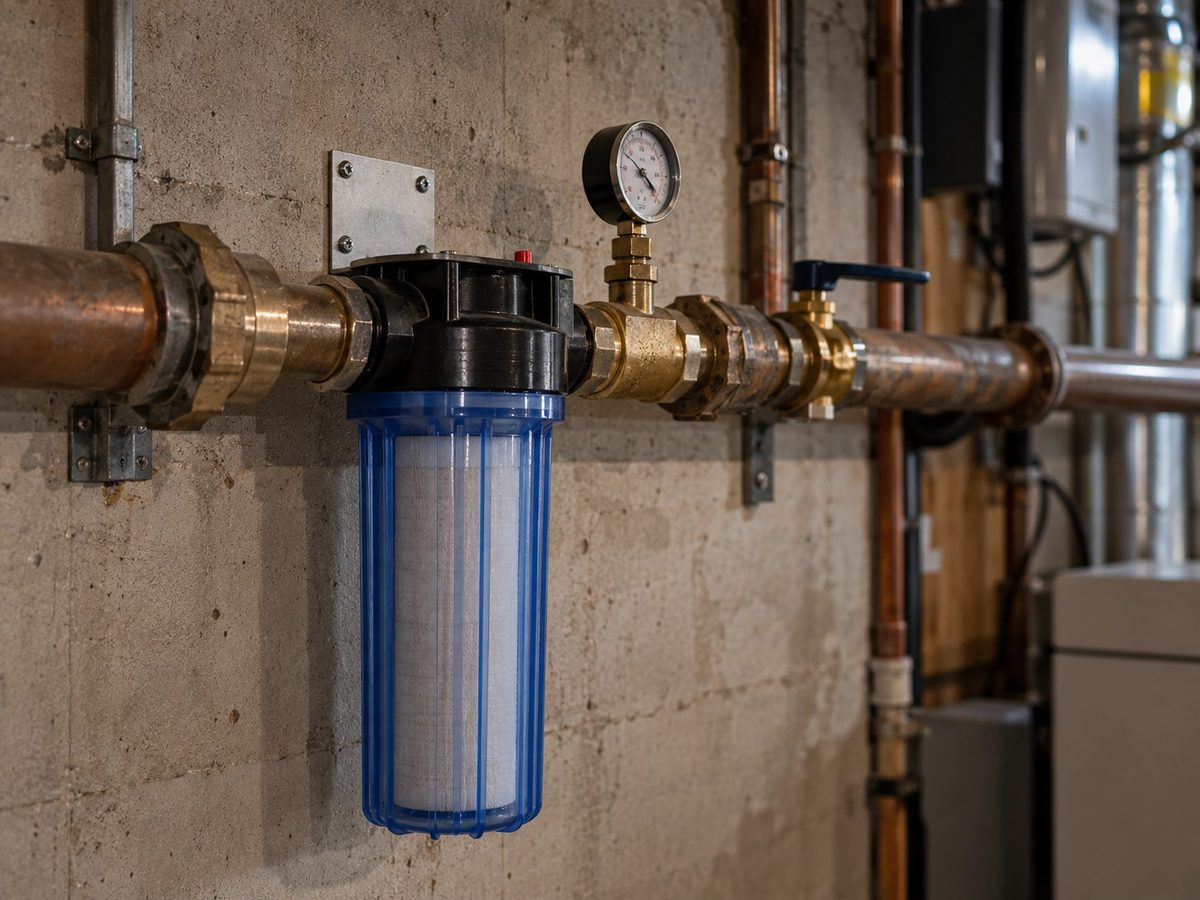
Every treatment vessel presents resistance to flow. Water enters at the top, travels down through a packed bed of media, and exits through a distributor at the bottom. That path costs pressure — measured as pressure drop across the vessel.
At low flow it's negligible. As flow increases, pressure drop rises sharply — not proportionally. Double the flow through an undersized vessel and you can more than double the pressure loss.
So a system that performs perfectly with one shower running can fall apart with a shower, a dishwasher and an irrigation zone going simultaneously. Which is when you'd notice.
The worse problem you can't see
Pressure drop is annoying. Channeling is the one that actually matters, and nobody mentions it.
Activated carbon works by adsorption, which requires contact time. The governing number is empty bed contact time — how long water spends in the media.
Push water through too fast and it stops flowing evenly through the bed. It finds paths of least resistance, carves preferential channels, and rushes through them. Water that follows a channel spends a fraction of the intended time in contact with the carbon.
So the undersized system doesn't just cost you pressure. It quietly stops doing its job at the moment it matters most, and there's no indicator light for that.
How design peak flow is actually calculated
Peak flow isn't your average use. It's the maximum simultaneous demand the house can plausibly place on the supply.
Our working first pass:
| Component | Contribution |
|---|---|
| Base household demand | 5 GPM |
| Per bathroom | +2.5 GPM each |
| High-flow fixtures — soaking tub, multi-head shower | +3 GPM |
| Multiple high-flow plus irrigation on the domestic line | +6 GPM |
Worked through:
| Home | Calculation | Design peak | Carbon |
|---|---|---|---|
| 2 bath, nothing unusual | 5 + 5 + 0 | 10 GPM | 2.5 cu ft |
| 3 bath, soaking tub | 5 + 7.5 + 3 | 15.5 GPM | 4.0 cu ft |
| 4 bath, tub + irrigation | 5 + 10 + 6 | 21 GPM | Estate class |
Note what isn't in that calculation: square footage, house value, ZIP code. A 4,000 sq ft home with two bathrooms and no high-flow fixtures has lower peak demand than a 2,200 sq ft home with three bathrooms and a soaking tub. We've sized systems both ways, and the smaller house sometimes needs the bigger filter.
Two things that cap what's achievable
Your service line. A ¾-inch line into the house limits flow regardless of what you install inside. No filter overcomes an undersized supply — and if we see a ¾-inch service on a five-bathroom house, that's a conversation before it's a quote.
Static and dynamic pressure. Static is pressure with nothing running. Dynamic pressure — measured under realistic simultaneous demand — is the number that actually reflects how the house feels. Plenty of homes show healthy static pressure and sag badly under load, and only the second measurement reveals it.
Below roughly 40 psi we look for the cause before we look at equipment. Above roughly 80 psi you need a pressure-reducing valve ahead of any treatment gear — high pressure damages equipment and fixtures alike.
Why a booster pump is usually the wrong answer
This is where the industry does real damage.
Pressure disappoints after a filter goes in. The easy fix is a booster pump. It works, in the narrow sense that pressure at the fixtures goes back up.
But consider what you've actually done. The filter was too small for the flow. You've now installed a pump that pushes more flow through that same undersized bed. Pressure improves; channeling gets worse. You've treated the symptom and amplified the cause, and you've added a mechanical device with a service life and a power draw to a system that didn't need one.
A booster pump must never be used to conceal an undersized filter. Size the treatment for the hydraulics first. Then — and only then — decide whether boosting genuinely helps.
There are legitimate uses. A home at the end of a long service line with genuinely low supply pressure benefits from boosting, and for very large homes we require professional booster sizing based on flow and head rather than defaulting to a familiar model. But the sequence matters: measure, size, then evaluate.
What to ask before you buy
- What design peak flow was this system sized for? If nobody calculated one, nobody sized it — they picked from a catalog.
- How many cubic feet of media? This is the performance number. "Premium filtration" is not a specification.
- What's the published service flow range for this vessel? Every manufacturer publishes it.
- What's my dynamic pressure under load? If the answer is a static reading, the test wasn't finished.
- What's my service line diameter? It can cap the whole system.
Five questions. Any competent supplier answers all five without hesitating, and the answers tell you whether you're buying an engineered system or a box.
Get sized properly
We calculate your design peak flow, check static and dynamic pressure, and size the equipment to the hydraulics — often smaller than you'd expect.
See how we size systemsQuestions we get about this
Why did my water pressure drop after installing a whole house filter?
What is channeling in a carbon filter?
How do you calculate design peak flow for a house?
Will a booster pump fix low pressure from my water filter?
Sources
- Central Alabama Water (formerly Birmingham Water Works). 2026 Annual Water Quality Report.
- International Code Council. 2021 International Residential Code — plumbing provisions adopted by the Alabama Plumbers and Gas Fitters Examining Board (Admin Code 720-X-1-.02).
- Water Quality Association. Technical resources on media filtration and service flow.