 Cahaba Water Co.
UV disinfection: when it's worth it, and when it's just an upsell
On compliant municipal water, UV is an additional barrier rather than a fix. There is one situation where it becomes genuinely important, and it isn't the one you'll be sold.
The short version
- UV inactivates microorganisms with light. No chemicals, no taste change, nothing added.
- On Birmingham municipal water it's an additional barrier, not a correction. The utility already disinfects.
- It becomes genuinely important when water is stored before distribution — residual disinfectant fades in a tank.
- Specify intensity monitoring. A UV lamp loses output gradually and an unmonitored unit fails silently.
UV is the easiest product in this category to sell dishonestly, because the pitch writes itself: invisible threats, bacteria in your water, a device that kills 99.99% of them. Frightening, technical-sounding, and largely irrelevant to a compliant municipal supply.
Here's the straighter version, including the case where UV genuinely matters.
How it works
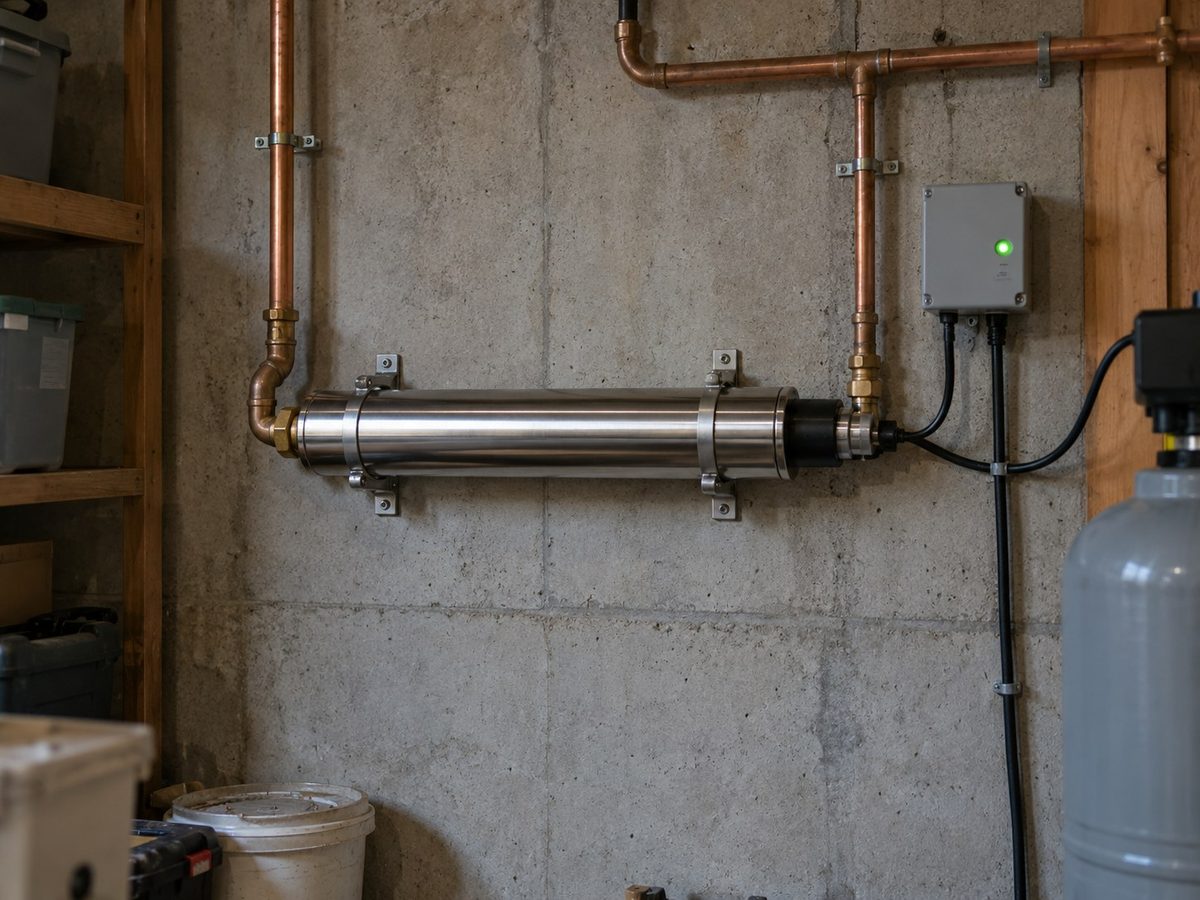
Water passes through a chamber containing a lamp emitting ultraviolet light at around 254 nanometres. That wavelength is absorbed by the nucleic acids of microorganisms and disrupts their DNA and RNA, leaving them unable to reproduce. An organism that can't replicate can't cause infection.
Nothing is added to the water. No chemicals, no byproducts, no taste change. The water leaves the chamber chemically identical to how it arrived.
That's genuinely elegant — and it's also why UV has a real limitation: no residual protection. UV works only inside the chamber. Downstream of it, water is unprotected. Contrast that with chlorine, which persists through the distribution system and keeps working all the way to your tap. The two do different jobs.
Why it's optional on Birmingham water
Central Alabama Water (formerly Birmingham Water Works) disinfects at the treatment plant and maintains a chlorine residual through the distribution system. The utility meets every federal and state standard, and the annual report shows no microbiological compliance problems.
So the question isn't "is my water disinfected" — it is. The question is whether you want a second, independent barrier at the point where water enters your home.
That's a legitimate thing to want. Redundancy has value, particularly after a main break or a boil-water notice, when the distribution system has been disturbed. But it's a want, not a need, and we'd rather frame it that way.
If anyone sells you UV as evidence that your municipal water is unsafe, that's the moment to end the conversation. Birmingham's water is compliant, and treating that as a scandal is a marketing tactic rather than an engineering judgment.
The case where it genuinely matters
Here's the situation that changes the calculation entirely: stored water.
If you've installed a potable storage tank — for outage resilience, boil- water notices, or pressure events — the chlorine residual in that water fades over time. It's consumed by reactions with organic matter and it dissipates. Water that arrived fully protected sits in a tank for days or weeks and gradually loses that protection.
Stored water, re-pressurized into a household plumbing system, without a residual disinfectant, is a genuinely different risk profile from water arriving directly from the main.
That's why UV is standard on any storage build we do, and why it's included on the Cahaba Whole Home Signature. It's not an upsell in that context — it's the component that makes storage defensible.
The specification detail that actually matters
If you do fit UV, there's one feature worth insisting on: UV intensity monitoring.
A UV lamp doesn't fail like a light bulb. It keeps glowing while its germicidal output declines — typically losing effectiveness across its service life, and further as the quartz sleeve around it fouls. A lamp that looks fine can be delivering a fraction of its rated dose.
An unmonitored system gives you no way of knowing. A monitored system measures actual output and alarms when it drops below the threshold.
We specify VIQUA UVMAX PRO series units for exactly this reason. They're NSF-certified PRO-series products with intensity monitoring included, and they're sized to peak flow rather than to a catalog default — because a UV unit rated for 20 GPM delivers its rated dose at 20 GPM. Push more through it and contact time falls below what the dose calculation assumed.
What UV doesn't do
- No chemical removal. Chlorine, PFAS, lead, hardness — UV addresses none of them. It works on living organisms only.
- No particulate removal. And turbidity actively interferes: particles shadow organisms from the light. UV belongs downstream of filtration, not instead of it.
- No residual. Protection ends at the chamber outlet.
- No taste improvement. Nothing about UV changes how water tastes.
How we'd advise
| Your situation | Our recommendation |
|---|---|
| Municipal water, direct from the main | Optional. Reasonable redundancy if you want it. Not a fix for anything currently wrong. |
| Municipal water with storage | Yes. Standard on every storage build. |
| Private well | Usually yes — but only after proper lab testing. Wells are a different conversation entirely. |
| Recent boil-water notice worry | Understandable, but the honest answer is that the event has passed and the utility has flushed. UV is for ongoing redundancy, not for reassurance after the fact. |
If you want it purely for peace of mind on municipal water, that's a fine reason and we'll fit it. What we won't do is tell you it's fixing a problem you don't have.
UV done properly
Intensity-monitored VIQUA PRO series, sized to your measured peak flow. Standard on Cahaba Whole Home Signature and on every storage build.
See Whole Home SignatureQuestions we get about this
Do I need UV disinfection on city water?
How does UV water treatment work?
What is UV intensity monitoring and why does it matter?
Does UV remove chlorine or PFAS?
Sources
- Central Alabama Water. 2026 Annual Water Quality Report — treatment process and microbiological monitoring.
- US EPA. National Primary Drinking Water Regulations.
- NSF International. Standards for water treatment systems.