 Cahaba Water Co.
The commercial work we are genuinely good at.
Restaurants, senior living, medical and dental offices, multi-family, storefronts, builders, and storage for buildings that cannot close. Seven kinds of building where the equipment, the plumbing and the service interval are work Cahaba Water Co. already does every week. On the first call we tell you plainly whether your building is one of them.
homes and buildings
quoted per building
plumbing contractor
after sizing
Everything we publish here, we can back.
What we have on the commercial side, stated plainly.
On the home side of this site we publish prices, name the parts and show the work. Commercial earns its credibility the same way, one building at a time: the equipment we install, the license that installs it, the sizing method, and a price in writing. Case studies, a client list and an installed-volume figure are things we will publish the day they are real.
What we can show you is more useful anyway. The equipment is the same equipment, the trade is the same trade, and a licensed Alabama plumbing contractor does the work. What changes on a commercial building is the scale, the permitting and the backflow position. We settle all three before anyone talks about price.
You will know on the first call whether this is work we take on. That answer is free, and it saves you two weeks.
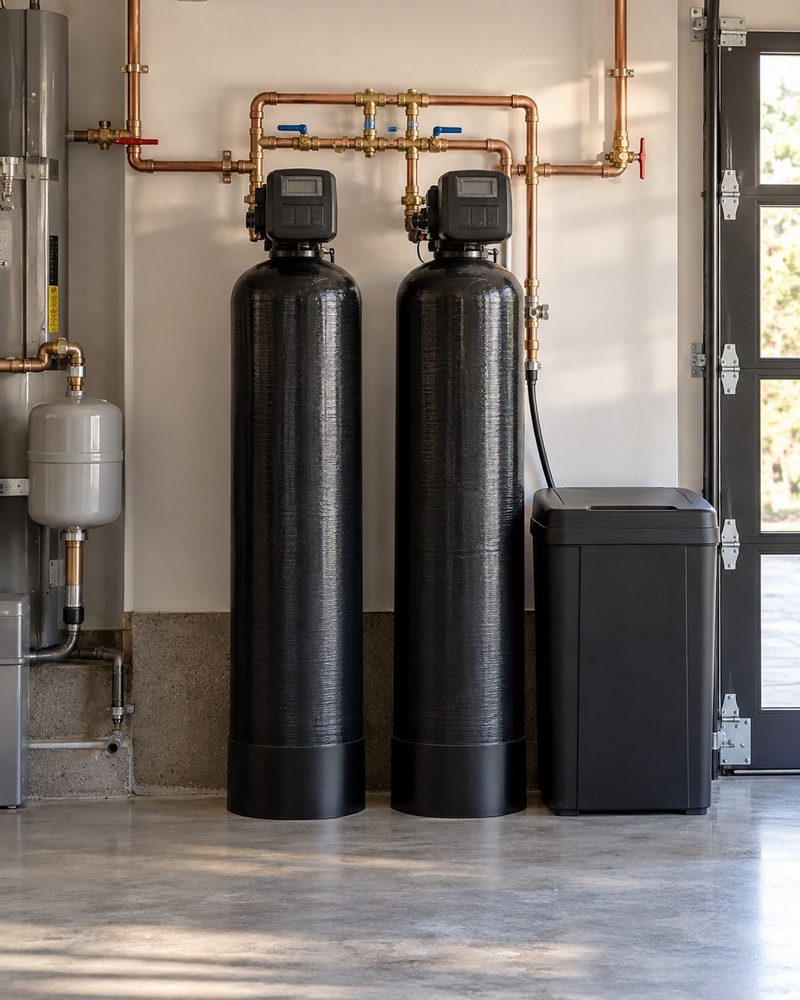
Work that sits close to what we already do.
Seven kinds of job we will look at.
What these have in common is that the equipment, the plumbing and the service interval all stay within what we handle every week. We confirm that fit on the first call.
Process water, boiler feed and cooling towers
Industrial pretreatment, wastewater, and anything discharged under a permit
Dialysis, laboratory, sterile processing, and any water feeding a medical device
Water that is an ingredient in a manufacturing process
Anything that needs a stamped engineering design or a daily operator
Where a job belongs to another trade, we point you to someone who does it, where we know one
Why those sit elsewhere
Each boundary has a reason worth knowing.
We treat water people drink. Three kinds of work sit outside that, each for its own reason, and each belongs to a different trade.
Water that enters a body any way but the mouth. Dialysis, sterile processing, anything feeding a medical device. During one dialysis treatment a patient's blood meets a very large volume of water across a membrane — far more than anyone drinks, and it bypasses the digestive tract entirely. What is harmless to swallow can be dangerous there. That work runs to its own standards, with continuous monitoring, redundant equipment and somebody whose entire job it is. It is a profession of its own.
Water that is an ingredient in a regulated process. Laboratory water, boiler feed, cooling towers, manufacturing process water. These are chemistry programs rather than equipment sales. Lab water is graded on resistivity and organic carbon, and somebody's published results depend on it. Boiler feed is dosed and blown down on a schedule, and getting it wrong damages a pressure vessel. Cooling towers carry Legionella risk and usually a discharge permit. Every one of them needs a person on site regularly. We install and we service. We do not operate.
Anything that needs an engineer's seal. Past a certain size and complexity the design has to be stamped by a licensed Professional Engineer. That is a separate license from plumbing, and working around it is its own offense. If your project needs a stamp, you need an engineer — and you will hear that from us on the first call.
A building is priced from how it actually runs.
Four things change once a building is involved.
All four have to be settled before anyone can put a number on the work.
Sized on the building, not from a table.
We size a house from its fixtures and from the pressure we measure. A commercial space is sized from how the building is actually used: the hours it runs, how many taps run at once, and how much of the day the equipment works. Houses get named size classes we publish; a building gets a site visit and a number built from its own measured demand.
Permitted and inspected differently.
Commercial plumbing is permitted, coded and inspected differently from residential plumbing, and the local authority decides what applies. A licensed Alabama plumbing contractor does the work, permitted where required.
Backflow prevention is usually in play.
Backflow prevention stops water running back out of a building into the city main. Commercial connections often have to carry backflow prevention and have it tested on a schedule, and the water utility sets those requirements. We have to establish that before we price the job, because it affects both the installation and the annual cost of owning the system.
Service becomes an agreement.
In a house we text you when filters are due and you schedule it when it suits you. A commercial site usually wants the firmer version: scheduled visits, agreed dates and something in writing, so responsibility for changing each part is settled on paper.
Commercial pricing is quoted per building. We size the job first, then put the price in writing with the backflow and permit position stated in it. We confirm that price with you before anything is scheduled.
Tell us what the building is doing.
Tell us how the space is used. The more detail you give us, the faster we can come back with a straight yes or no. This form starts the conversation; the price follows the sizing visit.
- 01A person reads it, and that same person calls you back
- 02You get a yes or a no, usually within a business day
- 03If it is a no, we point you onward where we can
- 04If it is a yes, we size the job first. The number comes after
See exactly how we work, before you call.
The residential side of this site publishes every price, names every part and shows the sizing method in full. Every figure that decides a price is on the page. It is the fastest way to judge us on a building.