 Cahaba Water Co.
Questions
Answers, including the ones that cost us a sale.
Including the ones where the answer costs us a sale, and the ones where the honest answer is that we don't know yet. Every figure below is sourced from a published report, and those sources are collected on the water quality page.
About Birmingham water
Your water.
Is Birmingham's water unsafe?
No. Central Alabama Water (formerly Birmingham Water Works) meets every federal and state drinking water standard and publishes its results annually. What we sell improves taste, odor and chlorine, reduces hardness where a test shows it is elevated, and — at the drinking tap — addresses contaminants the RO is certified for. Those are comfort and preference improvements on water that is already compliant.
Why did my water taste musty last spring?
Geosmin. A natural compound produced by algae in the reservoirs Birmingham draws from. The utility confirmed it during the May 2024 event across Homewood, Vestavia Hills, Mountain Brook and North Hoover. It's harmless, humans detect it at a few parts per trillion, and it recurs seasonally because surface water does this in spring. Reverse osmosis at the tap reliably fixes it. Whole-home carbon reduces it only partially at full flow.
What about PFAS?
The Central Alabama Water 2026 Annual Water Quality Report shows detectable PFOA and PFOS, both below the EPA limit. PFOS ranges 2.1–3.8 ppt; PFOA is reported at a highest value of 2.7 ppt, with results ranging from non-detect to 2.5 ppt. Both sit against a 4.0 ppt limit. Reverse osmosis is a recognized technology for reducing them; softening and whole-home carbon are different tools aimed at different problems. On the Cahaba Pure 50 we do publish a certification claim. The manufacturer's performance data sheet names the model and the compounds: IAPMO R&T certifies that configuration to NSF/ANSI 58 and CSA B483.1 including PFOA and PFOS reduction, at a minimum of 98.77%. We withdrew that claim once and restored it only after reading the document. We publish it for that system and no other.
I'm in Trussville — does this apply to me?
Not directly. Trussville is served by its own utilities board with its own sources and its own report. We'd look up their published data before recommending anything. Same for anyone on a private well — that's a genuinely different problem requiring proper lab testing.
Choosing a system
What you actually need.
Do I need a water softener?
A softener isn't automatic in Birmingham, and the only way to settle it is to measure. Central Alabama Water's 2026 Annual Water Quality Report puts total hardness across a wide band — 38 to 224 mg/L, or 2.2 to 13.1 grains per gallon — because the system draws from more than one source, so hardness varies by source and by location. At the low end of that band, softening buys you very little. The top end sits in the very hard range, where a softener does real work. A published spread that wide is a reason to test your own water rather than assume either answer, so we test your home's water before recommending a softener. We'll mail you a free test strip. If the number comes back low, we'll tell you and take the smaller sale. If the hardness level and your goals justify softening, we'll size the system accordingly. In a Cahaba whole-home system a softener follows the hardness result. The Langelier index is negative system-wide, meaning the water isn't scale-forming — a separate question from how hard it is. That describes Central Alabama Water. Trussville, Pelham and Alabaster publish their own figures, and on those systems the answer turns on which source serves your address.
Which system should I start with?
Most people start with the Cahaba Pure 50 at $995, because taste at the drinking tap is what actually bothers them and it solves that directly. If chlorine in the shower is the irritation, that's a different problem and the answer is Cahaba Whole Home Essential instead. Softening only enters the conversation after a hardness result. Plenty of people start with the RO and never need more, and we'd rather tell you that now than after you've bought a second system.
Do I need UV?
On municipal water, usually not. Birmingham's water is already disinfected and compliant — UV is an additional barrier, not a correction. Where it genuinely earns its place is when water is stored before distribution, because residual disinfectant fades in a tank. It is one of the options that can appear in a Cahaba Whole Home Signature design where it is appropriate. Appearing on the options list is different from being standard — every component earns its place house by house.
How do you decide what size?
Carbon capacity follows design peak flow — fixture count, fixture type, and what realistically runs at once. Softening follows measured hardness and usage. Pressure boosting follows a pressure test, and never gets used to mask an undersized filter. The full method is on How We Size. Size is a hydraulic question and nothing else — what your water gets treated for is settled separately, from your water.
The four RO systems, and the two whole-home decisions
How the range is put together.
What's the difference between the four RO systems?
Production, configuration, and what each one is documented for. Not, as far as anything we can prove, what comes out of the tap.
Cahaba Pure 50 — $995. Nominal 50 GPD, four stages, no booster pump, roughly a 4-gallon metal tank. IAPMO R&T certifies this configuration to NSF/ANSI 58 and CSA B483.1, including PFOA and PFOS reduction.
Cahaba Performance 75 — $1,095. Nominal 75 GPD, five stages, an integrated booster pump for homes where incoming feed pressure needs support. The manufacturer identifies the membrane and the storage tank as NSF certified. We do not claim complete-system certification for this platform.
Cahaba Signature 75 — $1,295. Our premium traditional-tank system. Nominal 75 GPD with a booster pump. The storage tank is identified as NSF certified. We do not claim complete-system certification for this platform. That sentence stands as written, at full price.
Cahaba Slim 800 — $1,295. No storage tank at all. A premium alternative, not a fourth rung.
Four products, four separate certification statements. Each claim stands for the product it names, and stays with it. A GPD figure describes production rate and a stage count describes an assembly; what comes out of the tap is a separate question, answered by the listing. The full register is on the equipment page.
Cahaba Pure 50 — $995. Nominal 50 GPD, four stages, no booster pump, roughly a 4-gallon metal tank. IAPMO R&T certifies this configuration to NSF/ANSI 58 and CSA B483.1, including PFOA and PFOS reduction.
Cahaba Performance 75 — $1,095. Nominal 75 GPD, five stages, an integrated booster pump for homes where incoming feed pressure needs support. The manufacturer identifies the membrane and the storage tank as NSF certified. We do not claim complete-system certification for this platform.
Cahaba Signature 75 — $1,295. Our premium traditional-tank system. Nominal 75 GPD with a booster pump. The storage tank is identified as NSF certified. We do not claim complete-system certification for this platform. That sentence stands as written, at full price.
Cahaba Slim 800 — $1,295. No storage tank at all. A premium alternative, not a fourth rung.
Four products, four separate certification statements. Each claim stands for the product it names, and stays with it. A GPD figure describes production rate and a stage count describes an assembly; what comes out of the tap is a separate question, answered by the listing. The full register is on the equipment page.
The Performance 75 and the Signature 75 both have a booster pump. So what is the extra money for?
The difference is the platform. Both systems have a booster pump — the pump is what separates the Pure 50 from the Performance 75, not what separates the Performance 75 from the Signature 75. The Signature 75 is a different and higher-specified platform. The Signature 75 is built on a high-efficiency RO design whose internal recirculation the manufacturer describes as recovering substantially more feed water than a conventional residential system. That is a manufacturer specification, and we present it as one rather than as a third-party certification claim. Nothing we hold documents a water-quality difference between the two, so treat them as equals at the tap. If what you want is more production and pump support, the Performance 75 already gives you both.
Is the Slim 800 better because it's tankless?
No — tankless describes the shape of the system, not its treatment. It makes water as you draw it instead of holding a reserve, which frees the cabinet floor and means the production rate is what fills the glass. Those are real advantages if cabinet space and on-demand production matter to you. They are not purity advantages. We publish no certification claim for the Slim 800 yet, because the documentation we would want to stand behind is still outstanding. If a certification statement is what you are buying, the Pure 50 is the system that carries one. The 800 GPD figure is production speed; reduction is a separate question, and the listing is where it gets answered.
Why are treatment level and system size two separate decisions?
Because they answer two different questions, and collapsing them is how homes get sold the wrong system.
Treatment level answers: what does this household actually want or need treated? That comes from your water — the report, a hardness result, and what's bothering you.
System size answers: how much water does this house have to pass at peak demand? That comes from your plumbing — service-line diameter, fixture count, what runs at once, and measured pressure.
Neither one predicts the other. A big house with six bathrooms, where the only complaint is the chlorine taste, may be correctly served by Cahaba Whole Home Essential at an XL Estate Flow size — a lot of water at once, one thing to treat. A small house with two bathrooms, where the owner wants everything — filtered water at every tap, softer water, our best drinking-water system, and UV — may be correctly served by Cahaba Whole Home Signature at an S Standard Flow size. Both of those are right answers. A finished system is named for both decisions — Cahaba Whole Home Complete ‑ M, for instance — because both were made. The size and tier page lays out the whole grid.
Treatment level answers: what does this household actually want or need treated? That comes from your water — the report, a hardness result, and what's bothering you.
System size answers: how much water does this house have to pass at peak demand? That comes from your plumbing — service-line diameter, fixture count, what runs at once, and measured pressure.
Neither one predicts the other. A big house with six bathrooms, where the only complaint is the chlorine taste, may be correctly served by Cahaba Whole Home Essential at an XL Estate Flow size — a lot of water at once, one thing to treat. A small house with two bathrooms, where the owner wants everything — filtered water at every tap, softer water, our best drinking-water system, and UV — may be correctly served by Cahaba Whole Home Signature at an S Standard Flow size. Both of those are right answers. A finished system is named for both decisions — Cahaba Whole Home Complete ‑ M, for instance — because both were made. The size and tier page lays out the whole grid.
Is Cahaba Whole Home Signature better than Cahaba Whole Home Essential?
It is broader, not better. Cahaba Whole Home Essential is whole-home carbon filtration. Cahaba Whole Home Complete adds softening where testing and your goals justify it, plus a Cahaba under-sink RO. Cahaba Whole Home Signature means the widest set of design options — higher-capacity carbon, appropriately sized softening where warranted, a premium RO, UV where appropriate, pressure management, monitoring, high-flow plumbing. Those are the options the design can draw on, chosen house by house. If whole-home carbon meets your goals, Essential is the correct system for your home, and that is where we would stop.
What do S, M, L and XL mean?
They are hydraulic sizes, not treatment tiers: S Standard Flow, M Enhanced Flow, L High Flow and XL Estate Flow. They describe how much water the system is built to pass at once. We do not publish flow breakpoints for these sizes. The size is set during the sizing visit from the incoming service line, the fixture count and type, simultaneous demand, and measured static and dynamic pressure. Square footage, home value, ZIP code and household size are useful context; the hydraulic evaluation of the actual house is what sets the number.
Signature 75 or Cahaba Whole Home Signature — which is which?
Two different products, and it is worth being exact about. Cahaba Signature 75 is an under-sink reverse-osmosis system at $1,295 installed. Cahaba Whole Home Signature is a whole-home treatment level, quoted after sizing. They are different products at different scales and one does not include the other. On this site the word always arrives with its full product name — Signature 75 or Cahaba Whole Home Signature — for exactly this reason.
Price and process
How buying works.
Is $995 really the whole price?
Yes, for a standard installation — an accessible cold-water shut-off under the sink, an existing faucet hole or a countertop we can drill, a standard trap, and cabinet room. Standard installation is included in the published price. If your home has an unusual site condition, we confirm it in writing before anything is scheduled.
Why is whole-home quoted after sizing?
Because a whole-home system is the product of two independent decisions, and a single published number would have to guess at both. Treatment level follows your water; size follows your plumbing. The same treatment level costs different money at S and at XL, and the same size costs different money at Whole Home Essential and at Whole Home Signature — so any headline figure would either over-serve smaller homes or under-serve larger ones. Whole-home is quoted after sizing. What we publish instead is the method, the components and the surcharge schedule, and then you get a firm written quote before anything is scheduled. Our under-sink drinking-water systems are the opposite case — one configuration, one installation, so those carry a fixed published price.
Will someone come to my house to sell me this?
No. We quote from your address, a couple of photos and — for whole-home — a pressure and flow assessment. The quote comes to you in writing, it reads the same on Friday as it did on Monday, and you can take as long as you like with it.
Who actually does the installation?
A licensed Alabama plumbing contractor, named on your contract with their PGFB registration number. Workmanship is warrantied 12 months. We handle everything up to the point where someone needs to touch the plumbing — that's a licensed trade, and it should be.
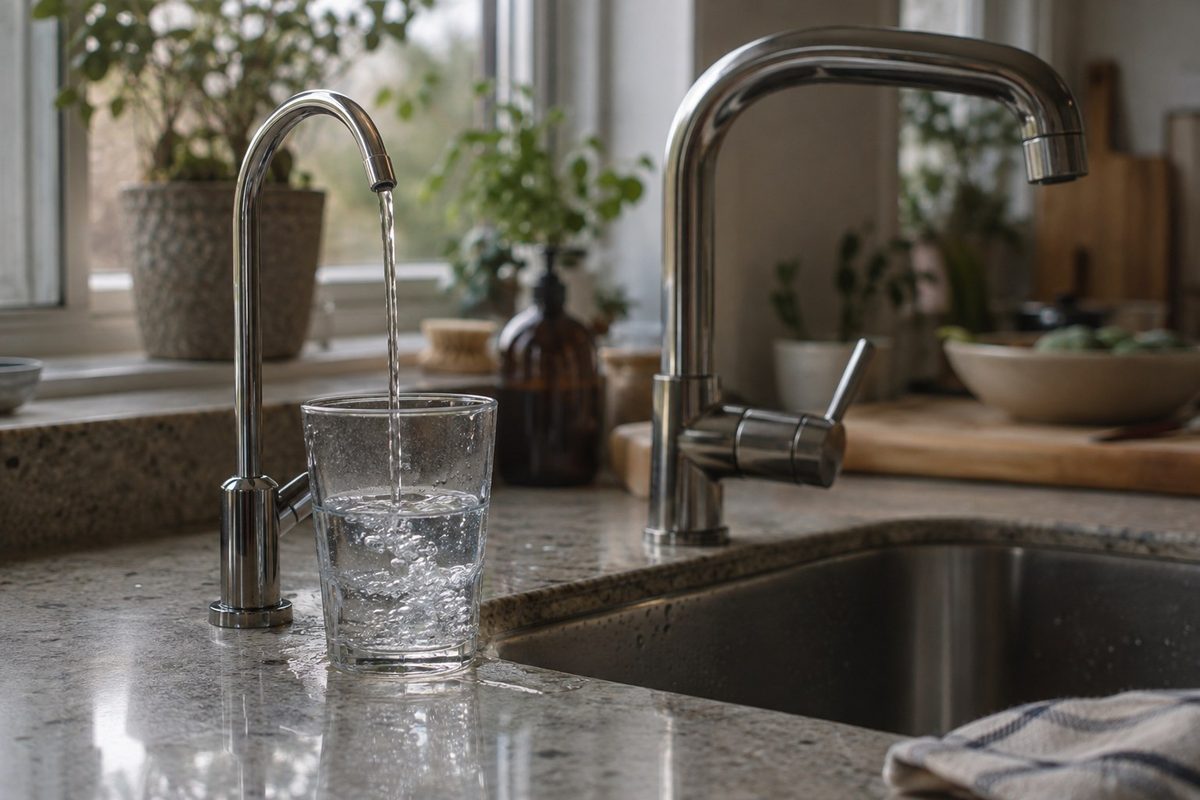
One tap
Reverse osmosis serves a dedicated faucet beside your existing tap, not the whole kitchen. Representative installation.
Living with it
After installation.
Can someone else service it later?
Yes, deliberately. We use standard Pentair Fleck and Clack platforms with parts available at any plumbing supply house. Any competent plumber can service what we install, and naming every component is what keeps that true. Staying our customer should be a choice you get to keep making.
How often do filters need changing?
RO prefilters and postfilter are typically annual; the membrane lasts longer. Carbon media is replaced on a multi-year cycle depending on volume and chlorine load. UV lamps are annual. We'll text you when yours are due. The reminder is free and standing, and the work is yours to book with us or handle yourself.
What's the warranty?
Workmanship is warrantied 12 months by the installing contractor. Equipment carries the manufacturer's warranty — typically 3 years on components and 10 years on the pressure vessel. We handle the claim either way; you don't chase two companies.
Does a softener add sodium to my water?
Yes. Ion exchange swaps hardness minerals for sodium — that's how it works. The amount is small and depends on your hardness, but it's a real consideration if you're managing sodium intake, and it's another reason a softener follows a test result rather than a default. An RO at the drinking tap removes it again if that matters to you.
Further reading
Still have a question?
Ask it directly — we'd rather answer honestly now than have you find out later. Most assessments come back the same day.