 Cahaba Water Co.
Yes, whole-home RO exists. It is the right answer for a narrow set of houses.
People ask for it because they already know reverse osmosis from the kitchen tap and assume the whole-house version is the same thing, scaled up. It is not. It is a different machine with a storage tank, a pump and a pH correction stage, and it is built to solve a problem most homes on Central Alabama Water do not have. We supply and specify these systems. We would rather explain what one is for before you buy it than after.
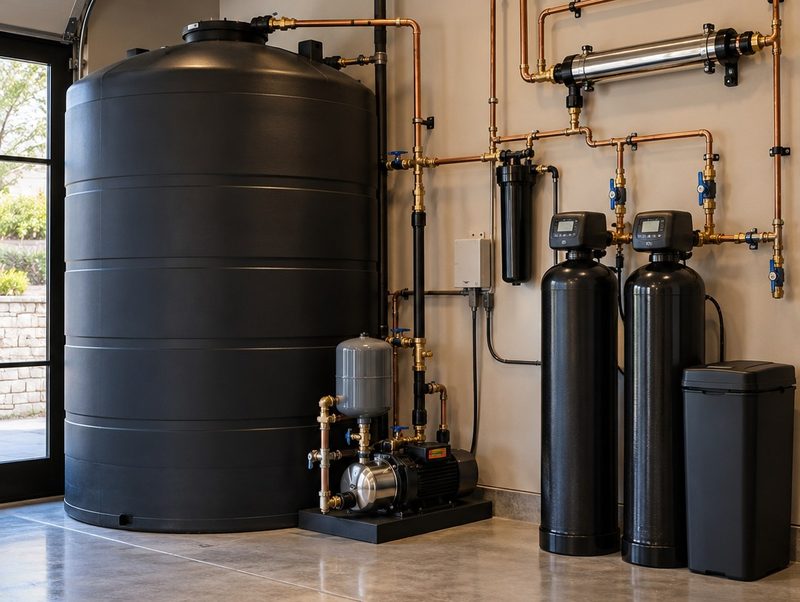
Four pieces of equipment, not one box.
An under-sink RO is a bracket of filters in a cabinet. A whole-home RO is a small water plant, and three of its four parts exist to work around what reverse osmosis cannot do on its own.
Why the pH stage is not an upsell. Water leaving an RO membrane has had most of its dissolved minerals and nearly all of its alkalinity taken out. That leaves it chemically hungry, and what it reaches for is the copper, brass and solder in your plumbing. At one fixture, on a short run of plastic tubing to a dedicated faucet, that does not matter. Sent through the whole house, it does. A whole-home RO that returns minerals and alkalinity to the water before it meets your pipes is a correctly designed one. A whole-home RO without that stage is a cheaper quote and a worse idea.
Rarely the right answer here, and the utility's own numbers are why.
Reverse osmosis exists to take dissolved solids out of water. The useful question is therefore how much dissolved material is in yours, and on Central Alabama Water that number is published every year.
Two of the other things whole-home RO is normally bought for sit comfortably inside their limits on this system as well. Chloride runs 3.93 to 10.0 mg/L against a secondary standard of 250, and sulfate runs 19.1 to 76.6 mg/L against the same 250. Sodium runs 1.27 to 12.6 mg/L.
So a whole-home RO installed on this water would be a large, powered, tank-and-pump installation built to remove something that is already well under its limit. Meanwhile the complaints people on this system actually have are chlorine taste, the musty taste that turns up in spring, and hardness at the upper end of a wide range. Those are a carbon problem and a softening problem, and they are answered by equipment that costs a fraction of this and needs no tank, no pump and no pH stage.
The same report lists a Langelier Saturation Index of -1.24 to -0.06, negative across the system. The utility labels that row non-corrosive, and a negative value means the water is not scale-forming
Water leaving an RO membrane sits a long way further down that same scale, because the minerals and alkalinity the index is calculated from are what the membrane removes
Putting whole-house RO permeate into household copper on a system whose index is already on the negative side, without a pH correction stage, moves the water in the wrong direction. It is a solvable design problem and not a reason the technology is bad. It is a reason the technology is wrong for a house whose water was fine to begin with.
Central Alabama Water meets every federal and state standard, and nothing on this page says otherwise. The published figures are on our Birmingham water page, and if you are on Trussville, Pelham, Alabaster or Shelby County, your system publishes its own.
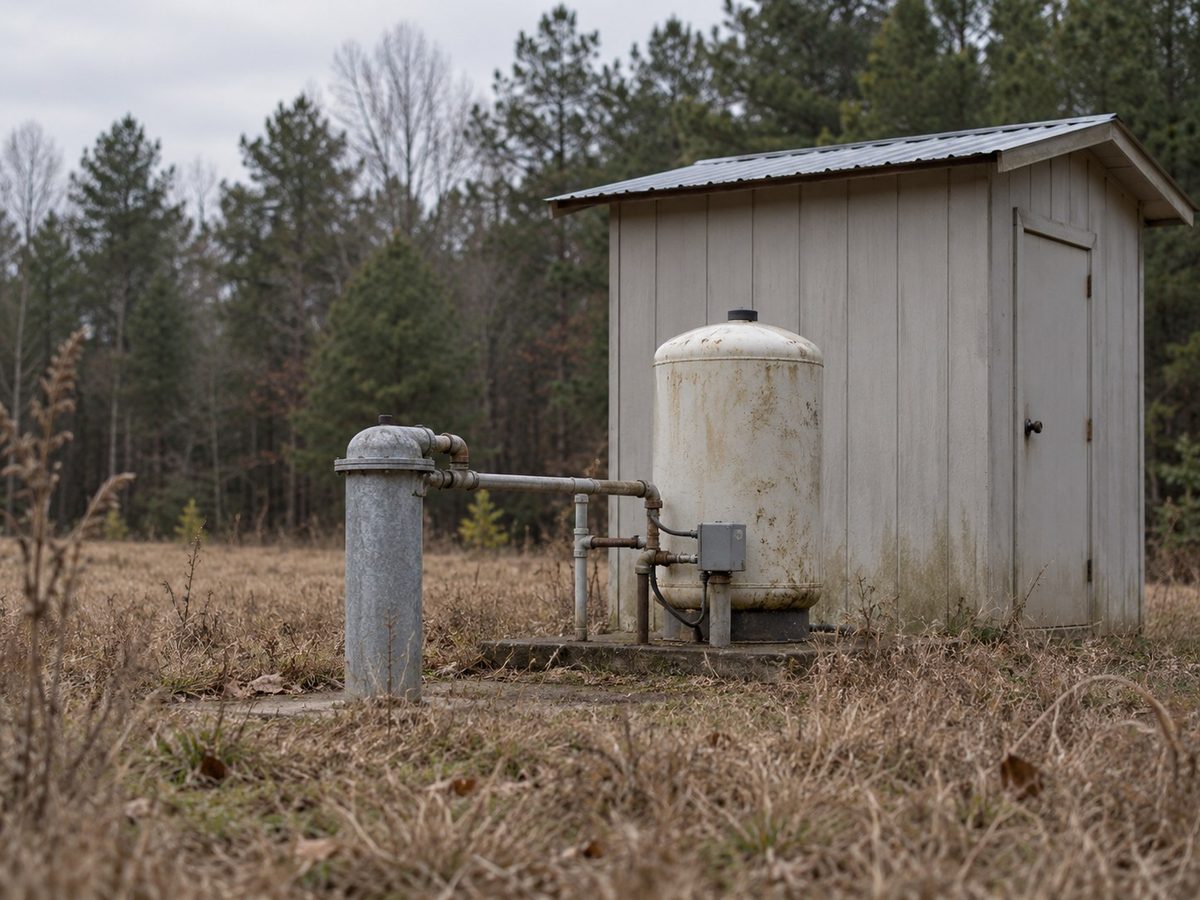
A lab result, above a number, affecting the whole supply.
Three conditions, and all three have to hold. A high reading at the kitchen tap alone is an argument for an under-sink system, not for this.
- Total dissolved solids above 500 mg/L. That is the secondary standard, and above it water starts to taste salty, brackish or mineral, and to leave deposits that carbon and softening do not touch.
- Chloride above 250 mg/L, or sulfate above 250 mg/L. Both are secondary standards, both are common reasons a well tastes wrong, and reverse osmosis is one of the recognized treatments once a result sits above them.
- Sodium high enough to matter to you. Softening adds sodium rather than removing it, so a sodium problem is one of the cases where a softener is the wrong tool and RO is the right one.
- The whole supply is affected, not one fixture. If the issue is what you drink and cook with, an under-sink system solves it for a small fraction of the money and none of the complexity.
- It is not disinfection. Reverse osmosis is specified for water that is already bacteriologically safe. If your panel comes back with coliform or E. coli, that is a disinfection question and a separate design, and it gets answered first.
- It is not a response to a test strip. A whole-home RO is specified from a certified laboratory panel, never from a strip and never from a description of the taste.
If your water comes from a private well, Alabama Extension's guidance is to test annually for total coliform, E. coli, nitrate, total dissolved solids and pH, and every two to three years for chloride, fluoride, sulfate, lead, hardness, calcium, copper, iron and manganese. That panel is where this conversation starts. Our well water page covers the rest of how a well build differs.
Before the water, the building.
A whole-home RO is as much a space and utilities question as a water-treatment one, and these are the four things that decide whether it is practical at your address.
What this costs. We do not publish a figure for it, and we are not going to estimate one on a web page. Whole-home installation pricing at Cahaba is in a pilot: our plumbing partner has returned flat, confirmed labor for under-sink work and has deliberately not rated whole-home configurations yet, because main-line access, equipment location and drain routing vary too much between houses to price in advance. A whole-home RO sits at the complex end of that range. You get an assessment, then a firm written number before anything is scheduled, and it reads the same on Friday as it did on Monday.
For almost everyone asking, the under-sink system is the answer.
It is the same technology at the one tap where it does the most good, and it is a published price with a single visit behind it.
An under-sink reverse osmosis system treats the kitchen cold line. It handles the water you drink and cook with, which is where taste, odor and the contaminants an RO is certified for actually reach you. It adds nothing to your main water line, needs no storage tank in the garage, no pump, no circuit and no pH correction, because the treated water travels a short run of tubing to a dedicated faucet rather than through the house.
Our four under-sink systems start at $995 installed, and the comparison page sets all four side by side, including how much water each one sends to the drain. If you came here because you want better drinking water, that is the page you want, and this one is not an upgrade on it.
And if the problem is every tap rather than one. Chlorine in the shower, or hardness through the house, are whole-home problems with whole-home answers that are not reverse osmosis. Carbon filtration handles chlorine taste and odor at every fixture. Softening handles hardness where a test shows it is genuinely high. Both sit in your main line, neither needs a storage tank, and that is whole-home treatment, decided from your water and sized from your plumbing.
Whole-home reverse osmosis, answered.
Do you offer whole-home reverse osmosis?
How is it different from the under-sink RO you sell?
Would one help on Birmingham city water?
Is RO water bad for my pipes?
I am on septic. Does that change anything?
Does it make well water safe to drink?
What does a whole-home RO cost?
How much room does it need?
Have a lab result, or think you need one?
Send it over, or tell us what the water tastes like and where it comes from. We will tell you whether this is a whole-home RO conversation or one of the much simpler ones, and we have no reason to prefer the expensive answer.