 Cahaba Water Co.
What a Birmingham restaurant actually needs from its water
You have been pitched a softener. Central Alabama Water publishes 2.2 to 13.1 grains per gallon, so the reading at your address decides this one.
The short version
- Central Alabama Water publishes 2.2–13.1 gpg — slightly hard at one end of the system, very hard at the other. Your address decides which.
- Carbon at the drinks stations is the upgrade a customer can taste, and it applies at every address in the metro.
- RO alone brews flat coffee. The SCA standard specifies a target mineral range, so shops brewing on RO remineralize on purpose.
- Trussville, Pelham and Alabaster publish their own ranges, 4.4 to 11.9 across the three. Hardness is a local question on every system here.
If you run a restaurant in this metro, someone has pitched you a water softener. The pitch is usually the same shape: hard water is destroying your equipment, here is a system, here is a monthly rate.
It may well be the right system for your building. The part worth slowing down for is the number underneath it, because in this metro that number moves more than most people expect.
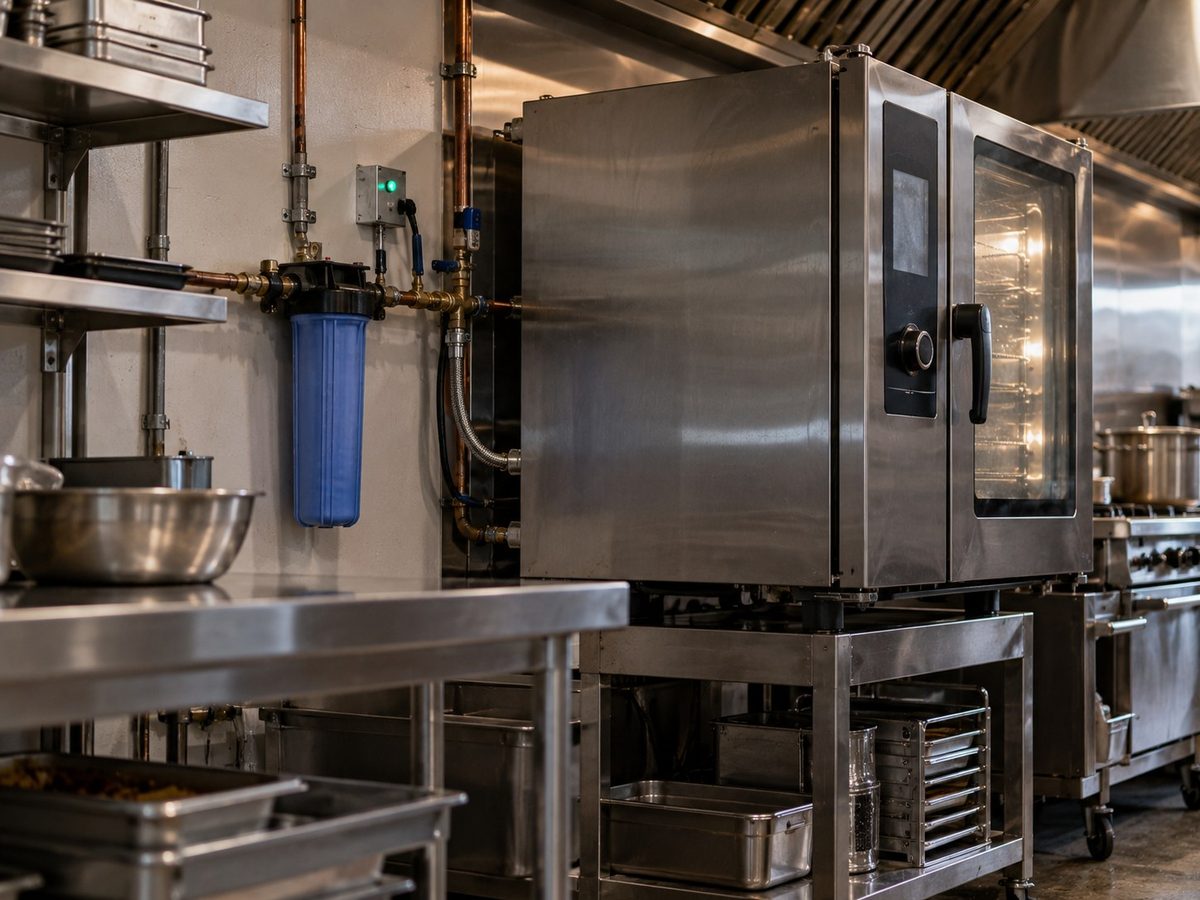
Where the scale pitch comes from
National water treatment sales material is calibrated for hard-water markets. In Phoenix, Las Vegas or San Antonio, municipal water runs roughly 15 to 25 grains per gallon. At those numbers scale is a maintenance reality rather than a sales angle — dish machines fail, steamers crust up, boilers scale, and softening is simply how food service operates there.
Central Alabama Water (formerly Birmingham Water Works) publishes total hardness of 38 to 224 mg/L, which is 2.2 to 13.1 grains per gallon. Read both ends of that range: the low end is slightly hard, and the high end sits in the very hard band on the same scale the national pitch uses. One utility, one metro, and two kitchens ten miles apart can land on opposite ends of it.
The utility also reports a negative Langelier Saturation Index system-wide, meaning the water is not scale-forming by that index. That figure answers a different question than hardness does — the index describes the water's tendency to deposit or dissolve calcium carbonate, while hardness is the mineral load a softener would remove. Either way, a machine that boils water concentrates what is dissolved in it.
So a pitch built around one fixed number, delivered unchanged to every address in the metro, is answering a question it never asked. Your reading might land near the top of the published range, and then the scale conversation is a real one. It might land near the bottom. A test at the building settles it.
Which utility bills you sets the starting range. Trussville publishes 8.9 grains per gallon from eight limestone wells, system-wide. Pelham runs 4.4 and 11.9 depending on supply, and Alabaster 5.0, 5.6 and 11.4. Set those beside Central Alabama Water's 2.2 to 13.1 and the pattern holds across the whole metro: hardness here is a property of the source and the address rather than of the name on the bill. Check which utility serves you first, then measure — in that order.
What a Birmingham kitchen actually needs
Ranked by how often it is the thing that matters, in our experience in this specific metro.
1. Carbon at the drinks stations
Coffee, tea, soda, ice. This is where water quality becomes something a customer can taste, and it is where Birmingham's surface-water profile shows up. Chlorine is present year-round; in spring the reservoirs can produce geosmin, which people detect at a few parts per trillion. Coffee is roughly 98% water, so whatever is in the supply arrives in the cup.
2. Sediment protection ahead of anything expensive
Cheap, and it protects solenoids, valves and the small orifices in espresso and steam equipment. This is the least glamorous line item and one of the highest-return ones.
3. Scale management where the equipment is sensitive
The specific machine rather than the whole building — a steam oven, a combi, an espresso boiler. Whatever your hardness reads, these run hot enough to concentrate what is dissolved in them, and manufacturers usually specify a hardness range for warranty purposes. Read your equipment's own spec sheet and match the treatment to it; that sheet is the specification that governs.
4. Backflow protection where the code requires it
A plumbing requirement rather than a water quality upgrade, and one the health department actually checks. Carbonators are the usual finding. That is its own article.
5. A softener, sized to a measured result
Last, and on a measurement taken at your building. Central Alabama Water's published range runs from slightly hard to very hard, which makes this the step that genuinely turns on your address. If the number comes back low, we will tell you that. If the hardness level and your goals justify softening, we size the system to the reading.
The coffee problem is not the scale problem
If coffee is a meaningful part of your revenue, the water conversation changes shape entirely, because now you are engineering a flavor rather than protecting equipment.
The Specialty Coffee Association publishes a water standard for brewing, and the thing that surprises people is that it specifies a target range for dissolved minerals rather than a minimum. Water with too little mineral content extracts poorly and tastes flat and hollow. Worth saying plainly, since we sell reverse osmosis systems: RO strips minerals, which is why shops brewing on RO remineralize afterwards on purpose. The SCA target is a destination you build toward, and RO is one step along the way.
Which means the honest version for a cafe is: measure what you have, decide the flavor you want, and build toward the target. It is a more interesting problem than "install a softener," and it starts with knowing what comes out of your tap.
About the monthly rate
A lot of food-service water treatment is sold as equipment you never own, on a multi-year agreement, with cartridges priced through the same contract. That model can work well — predictable service has real value in a kitchen, and somebody else remembering the filter change is worth something.
What is worth checking before you sign:
- What the cartridges cost outside the agreement. If they are proprietary and available only through the vendor, the cartridge price is the real price.
- What happens at the end of the term. Who owns the hardware, and what renewal looks like.
- What measurement justified the specification. Ask for the number and the date it was taken.
- Whether the proposal names your utility and your reading. Central Alabama Water spans 2.2 to 13.1 grains per gallon on its own, so a specification written without your address skipped the number that decides it.
What we would say walking into your kitchen
We would ask which utility bills you and where the building sits, because that pair sets the range before anyone measures anything. We would ask what actually bothers you — a taste complaint, a piece of equipment failing, an inspection finding, or a proposal you want a second read on. Those four lead to four different answers and only one of them is a softener.
Then we would measure. If the number comes back low, we will say so and quote the smaller thing. If it comes back near the top of the published range, we will say that too, and size the softener to your reading rather than to a national average.
Sometimes that means the smaller invoice, and we would rather be the company whose number you can check. The restaurants in this town talk to each other.
Get the number before you get the quote
We test your water first and quote to the reading. On a system that publishes 2.2 to 13.1 grains per gallon, that is the order that makes sense.
Commercial water treatmentQuestions we get about this
Does a Birmingham restaurant need a water softener?
What water treatment does a restaurant actually need in Birmingham?
Is reverse osmosis good for coffee?
Why does my restaurant coffee taste different from home?
Should I sign a monthly water treatment agreement?
Sources
- Central Alabama Water. 2026 Annual Water Quality Report — total hardness, Langelier Saturation Index, source water.
- Specialty Coffee Association. Water quality standard for brewing — target ranges for dissolved minerals.
- Trussville Gas & Water, Pelham Water Works and Alabaster Water Board Consumer Confidence Reports — hardness figures summarized here.