 Cahaba Water Co.
Why a pitcher filter can't fix your shower
Point-of-use and point-of-entry are not competing products. They solve different problems, and confusing them is the most common and most expensive mistake in this category.
The short version
- Point-of-use treats one tap. Point-of-entry treats the whole house. They are not tiers of the same thing.
- Taste and drinking-water contaminants are a point-of-use problem. Chlorine in the shower is a point-of-entry problem.
- Price is a poor guide here. The cheaper system is often the one that fits the problem.
- A useful test: does the problem happen somewhere other than the kitchen sink?
Almost every conversation we have starts in roughly the same place. Someone has a water problem, they've looked at options, and they're trying to work out whether the $200 thing, the $1,200 thing or the $4,000 thing is the right answer.
The honest answer is that those are three answers to three different problems rather than three grades of one product. Price tracks the size of the equipment, not the size of your problem. Here's the distinction, laid out plainly, because it settles most of the decision on its own.
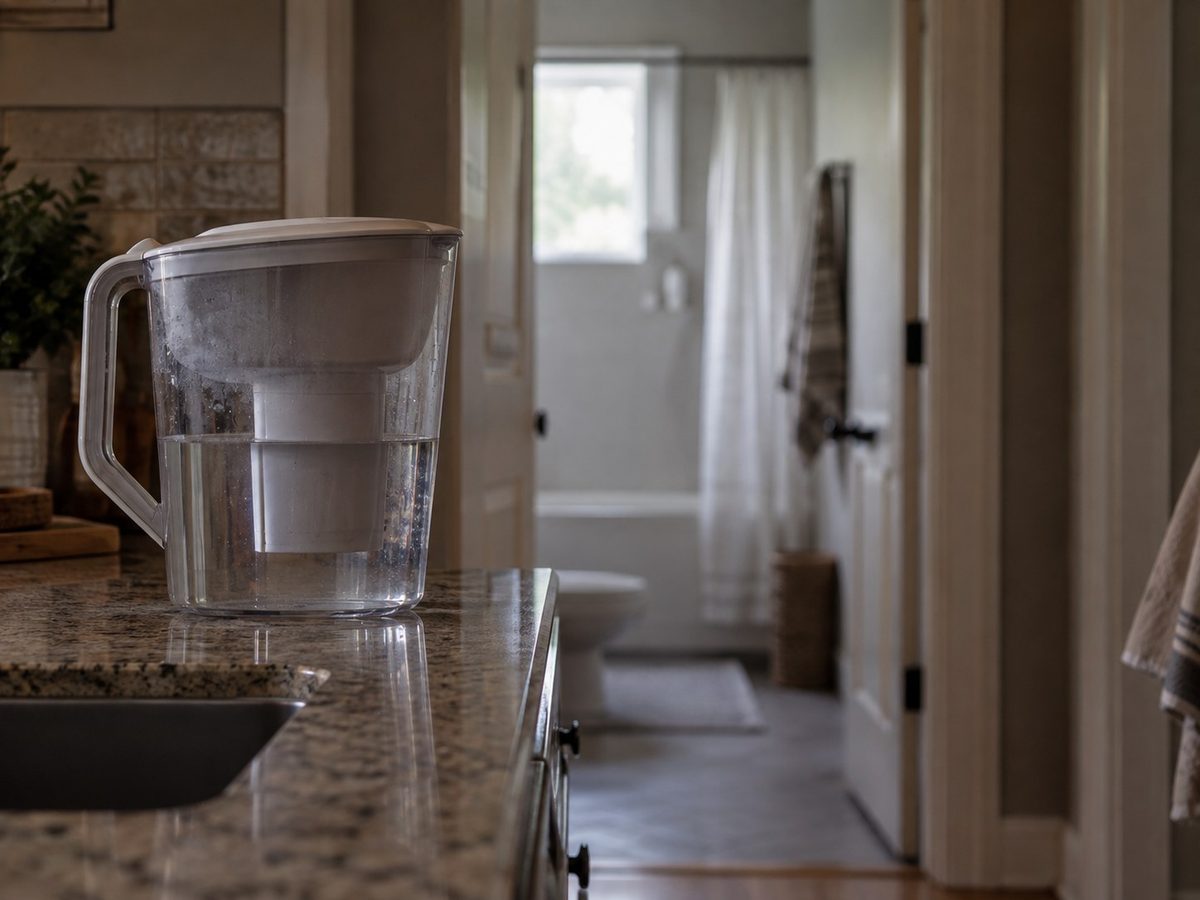
Point-of-use versus point-of-entry
Point-of-use equipment treats water at a single fixture. A pitcher, a faucet-mount filter, an under-sink reverse osmosis system. It sits at the end of the line, does its job on a small volume, and everything else in the house carries on untreated.
Point-of-entry equipment treats water where it enters the building, before it branches off to anything. Water softeners, whole-home carbon filters, UV systems. Everything downstream gets treated water — showers, baths, laundry, the kitchen, the outside hose bibb.
That's the whole distinction. It sounds almost too simple to be worth an article. But it determines which problems each category can physically address, and that's where people get caught out.
The test that resolves most of it
Ask one question: does your problem happen somewhere other than the kitchen sink?
If the answer is no — the water tastes off, you don't love drinking it, you're worried about something specific in the drinking water — that's point-of-use. An under-sink reverse osmosis system is almost certainly the right call, and it costs a fraction of a whole-home build.
If the answer is yes — the shower smells like a swimming pool, your skin feels tight afterward, the laundry comes out stiff, there's scale on the glass shower door — no amount of point-of-use equipment will help. Those problems occur at fixtures a drinking water filter never touches.
| Problem | Where it shows up | What actually addresses it |
|---|---|---|
| Drinking water tastes bad | Kitchen tap | Point-of-use RO |
| Seasonal musty or earthy taste | Kitchen tap | Point-of-use RO (whole-home carbon helps partially) |
| Specific certified contaminant reduction | Kitchen tap | Point-of-use RO, certified for that contaminant |
| Chlorine smell in the shower | Every hot fixture | Point-of-entry carbon |
| Skin and hair feel after showering | Showers and baths | Point-of-entry carbon |
| Scale on fixtures and glassware | Whole house | Point-of-entry softening, where measured hardness justifies it |
| Stiff laundry, poor detergent performance | Laundry | Point-of-entry softening |
Why this trips people up
Three reasons, and they compound.
The category names get stretched. "Whole home filtration system" is a phrase applied to plenty of products that treat a single fixture. The install location tells you the truth: if it fits under your sink, it treats that sink.
The diagnostic question comes last, when it belongs first. A process that runs "come in, let us test your water, here are three packages" can reach a recommendation while the question of where the problem occurs is still open. Where it occurs is the single fact that determines the answer, so that is where we start.
The chlorine case, specifically
This is the one where the distinction has real consequences, because the exposure story is counterintuitive.
Research published in Environmental Health Perspectives measured blood trihalomethane levels after specific household activities. Showering produced an average increase of 358 pg/mL at a higher-THM site. Drinking cold tap water produced roughly 20 pg/mL or less. Hot water, aerosolized into a steam-filled room, moves volatile compounds into the air far more effectively than a glass of cold water moves them into your digestive tract.
So for chlorine and its byproducts, the majority of household exposure happens at fixtures that a drinking-water filter cannot reach. We wrote that up properly here, including how much a shower-head filter can do in the contact time it has.
Chlorine exposure is a whole-house question. Treat it where the water enters the building and every fixture is covered at once.
When you genuinely need both
Plenty of houses do, because the two systems address genuinely different things.
Point-of-entry carbon handles chlorine at every fixture. Point-of-use RO handles the drinking water, including contaminants that carbon isn't the right tool for. Our Whole Home Complete and Whole Home Signature systems both include the RO for exactly this reason: carbon and RO cover different ground, so we build both in and the drinking water is handled on purpose.
Softening is a separate decision, and we make it on a measurement. A water softener isn't automatic in Birmingham. Central Alabama Water's published hardness runs from 2.2 to 13.1 grains per gallon depending on source and location — slightly hard at one end of that range, very hard at the other. A spread that wide is a reason to test rather than to assume in either direction. We mail a test strip and read your number first. If it comes back low, we'll tell you. If the hardness level and your goals justify softening, we size the system accordingly.
A reasonable order of operations
- Work out where your problem happens. Kitchen only, or everywhere?
- If it's kitchen only, stop there. An under-sink RO at $995 installed solves it, and you're done.
- If it's everywhere, look at point-of-entry — and get the carbon sized on measured peak flow, not on square footage.
- Add softening when your measured hardness supports it. The published range is wide enough that your own number is the only one worth acting on.
Most people who call us describing a whole-home problem do have one. But a meaningful share describe something that turns out to be purely about drinking water, and those conversations end with a smaller sale and a customer who got the right thing. That trade is fine by us.
Get your water assessed
No appointment, no sales visit. We size the system to your measured water and flow, then quote in writing.
Start an assessmentQuestions we get about this
What is the difference between point-of-use and point-of-entry water treatment?
Can an under-sink filter treat my shower water?
Do I need both a whole-home filter and a drinking water system?
Sources
- Nuckols JR, et al. "Influence of Tap Water Quality and Household Water Use Activities on Indoor Air and Internal Dose Levels of Trihalomethanes." Environmental Health Perspectives 2005;113(7):863–870. PMC1257647
- Central Alabama Water (formerly Birmingham Water Works). 2026 Annual Water Quality Report (2025 monitoring data) — total hardness.
- NSF International. Standards for water treatment systems.