 Cahaba Water Co.
Storing water you do not expect to need
Most people who buy a tank are not preparing for collapse. They went through one bad week and decided not to do it again. That is a good enough reason.
The short version
- Most buyers have already been through one — a main break, a notice, an ice storm. Not a scenario, a memory.
- On a well it is practical, not philosophical. No power means no pump means no water, immediately.
- If you are in town, on city water, with no medical need and somewhere to go for two days — this is a convenience, not a necessity, and we will say so.
- Cheaper resiliencies return more: bottled water, knowing your shutoff, a written plan. Do those first.
Most people who put a water tank in their garage are not preparing for the end of anything. They lived through a main break, or a week of boil-water notices, or the ice storm where the power went out for four days and the well pump went with it. They decided they would rather not do that again.
Some of them just sleep better knowing it is there. That is a good enough reason, and we are not going to make you justify it to us.
The problem with how this usually gets sold
Water storage sits in an awkward commercial position. The people selling it have two obvious moves and both are bad.
The first is fear. Describe a scenario, make it vivid, imply it is imminent, close. It works on some people and it is corrosive, because it requires the seller to keep escalating and the buyer to stay frightened. We are not doing that. Central Alabama Water (formerly Birmingham Water Works) runs a large and generally reliable system, and if we needed you to believe otherwise to sell you a tank, the tank would not be worth buying.
The second is condescension — the wink, the "some of our customers like to be prepared," the careful distance the seller keeps from the thing they are selling. That one is worse, honestly. It takes somebody's money while implying they are a little bit silly.
There is a third option, which is to treat this the way insurance is treated: a known cost against an uncertain event, bought by sensible people, requiring no prediction about the future and no story about what kind of person you are.
What people actually buy it for
In our experience the reasons cluster, and none of them are dramatic.
- They have been through one. This is the most common by a distance. A main break, an extended boil-water notice, a week of bad pressure. The experience was worse than expected, and they are not interested in repeating it.
- They are on a well. No power means no pump means no water, immediately and completely. There is no municipal pressure to coast on. This is a different situation from town and it is the most practical case on the list.
- Somebody in the house needs water reliably. A medical situation, an infant, an elderly parent. The stakes are not abstract and the calculation is not really a calculation.
- The property is remote. A lake house or a farm where nobody is coming quickly and you are effectively the utility.
- They would rather not think about it. The tank is there, it is full, and the question is closed. This is the one people are shyest about saying and it is completely legitimate.
If you are thinking about more than a main break
Some people reading this are not worried about a water main. They are thinking about longer disruptions, less predictable ones, and a general view that self-sufficiency is a reasonable thing to build toward.
We are not going to talk you out of that or treat it as eccentric. A household that can supply its own water for a couple of weeks is more robust than one that cannot, and that is true regardless of what you think is likely. Redundancy in a system is good engineering, and a house is a system. People who keep a generator, a full pantry and a way to get water are applying the same reasoning a hospital applies, at a smaller scale.
What we will do is be straight with you about what equipment does and does not deliver, because that is where this space fails people most often:
- Stored water is genuinely useful and genuinely finite. Do the arithmetic and know your real number rather than a number somebody printed on a brochure.
- Water and power fail together. A tank you cannot pressurize is a tank you can carry buckets out of. Plan them as one problem.
- A renewable input beats a bigger tank past a certain point. A well, or rainwater with appropriate treatment, changes the shape of the problem in a way that another 500 gallons does not.
- Treatment is not magic and we will tell you its limits. Every filter has a capacity and a set of things it does not address. Anyone selling you a device that handles "anything" is not being honest with you, and you should hold us to that standard too.
- Stored water does not exempt you from a boil-water notice. That is a regulatory instruction about the potable supply, and the answer comes from your health department and your utility, not from us.
The part where we argue against ourselves
There are households this does not make sense for, and it is worth naming them.
If you are in town on municipal water, in a house with a normal occupancy and no particular medical need, and you can go stay with family for two days without it being a crisis — storage is a convenience, not a necessity. It is fine to buy a convenience. It is not fine for us to sell it to you as something else.
If money is tight, there are cheaper resiliencies that return more. Bottled water in a closet costs almost nothing and covers the drinking case entirely. Knowing how to shut off your own main prevents a category of disaster. A plan written down beats equipment bought without one. Those cost us the sale and we would still rather you did them first.
What it is actually like to own one
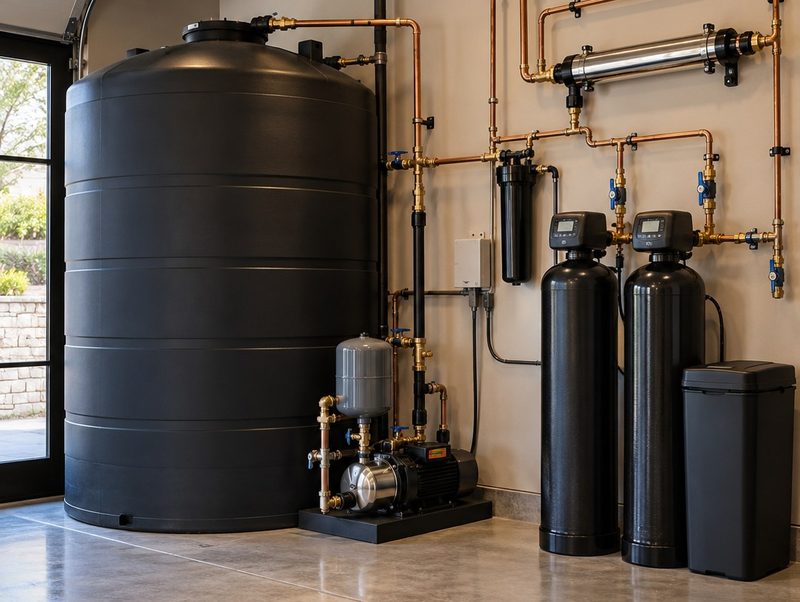
Undramatic, which is the point. It sits in the garage or beside the house. The water in it is treated and turned over rather than left to sit. There is a filter to change on a schedule. Most years nothing happens.
Then one February the pressure drops, or a notice goes out, and the house keeps working while the group chat fills up with people asking whether anyone has water. You do not feel vindicated, particularly. You feel like you handled something in advance.
That is the whole product. Not a prediction about the world, and not a statement about you — just a household that has one fewer thing that can go badly wrong.
Work out your own number first
Tell us what an outage means for your household. If the honest answer is that you do not need a tank, that is an answer we give regularly.
Water resilienceQuestions we get about this
Is water storage only for preppers?
Is it worth storing water if I am on city water in town?
Why is water storage more important on a well?
Does stored water mean I can ignore a boil-water notice?
How much does peace of mind cost?
Sources
- Consumption ranges used in the linked arithmetic are stated on the resilience page rather than converted into a days-of-supply claim.