 Cahaba Water Co.
Rainwater in Alabama: what is legal, and what changes when you want to drink it
Collecting it is straightforward. Plumbing it into your house or drinking it moves the question out of property law entirely.
The short version
- Collecting it is generally fine. Alabama has no statewide prohibition of the kind some western states have.
- Potable use is a different question entirely — plumbing code, cross-connection control, disinfection, and possibly permits.
- Your roof is part of the treatment system, and it is the part you cannot change later.
- PROFESSIONAL CONFIRMATION REQUIRED for any potable connection. Licensed plumbing contractor plus your authority having jurisdiction.
Alabama is a good state for collecting rainwater and a complicated one for drinking it. Those are two different questions and almost everything written about the subject blurs them.
The short version: collecting it is straightforward. Putting it into your house's plumbing, or drinking it, moves the question out of property law and into plumbing code and public health — and that is where the real requirements live.
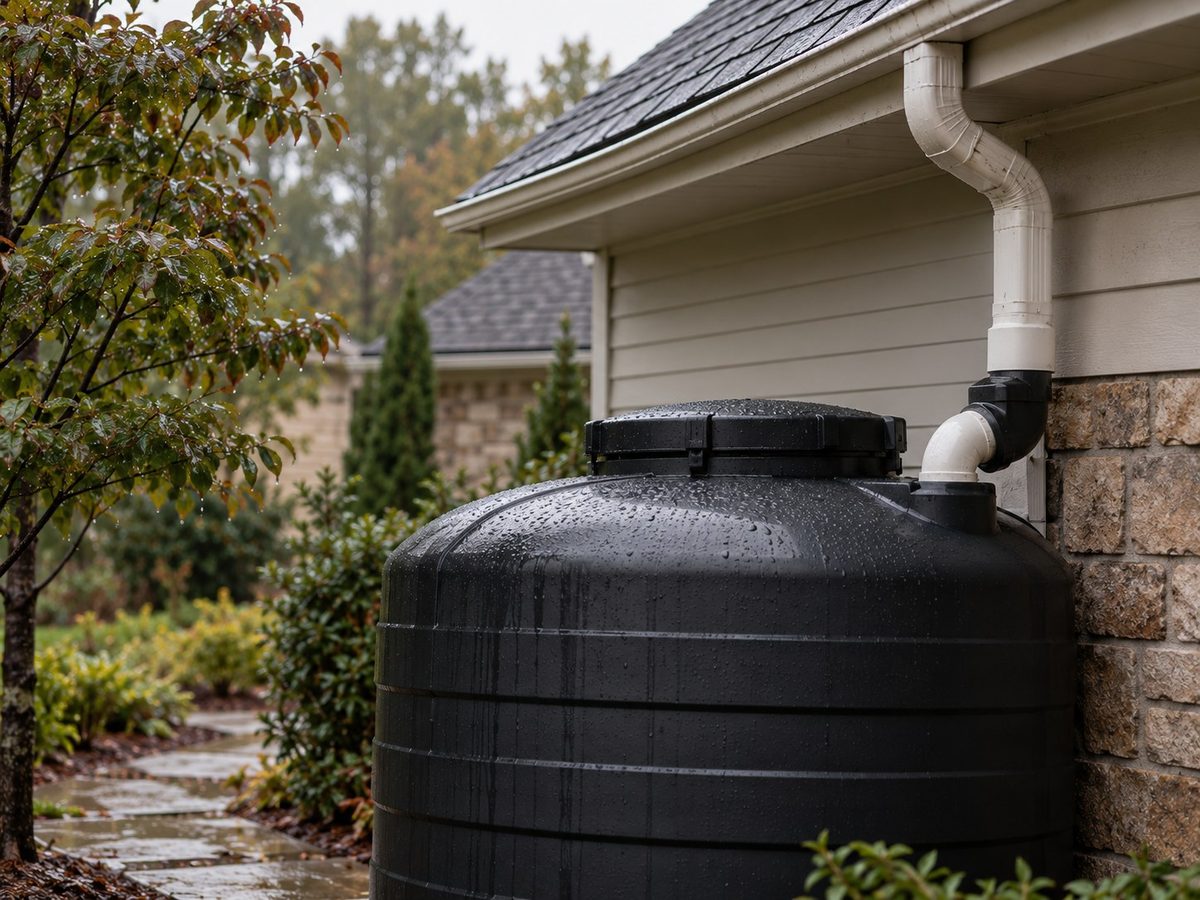
Collecting it
Alabama follows the eastern US pattern on water rights, and rainwater falling on your property is generally yours to capture. There is no statewide prohibition on rainwater harvesting of the kind that exists in some western states, where prior appropriation doctrine historically made capture a legal question.
So a barrel under a downspout, a cistern collecting off a barn roof, or a tank for irrigation is ordinarily an unremarkable thing to own here. Most people's rainwater project is exactly this, and for irrigation, washing, topping up a pond or watering stock it raises very little.
Local rules still exist. Homeowners associations, municipal ordinances, and subdivision covenants can all have views about tanks — usually about appearance, placement and setbacks rather than the water itself. Check yours before you buy a 1,500-gallon cistern. That is a different kind of problem from a legal one, and a more common one.
Where the question changes completely
The moment rainwater is intended for potable use — drinking, cooking, bathing, washing dishes — or is plumbed into a building's water distribution system, you are in a different regulatory world.
Three things become live at once:
Plumbing code
Alabama's plumbing code governs how any non-potable or alternate water source may be connected to a building. The central concern is cross-connection: preventing a non-potable supply from ever reaching the potable system, whether by backflow or back-siphonage. This is the same body of practice that governs carbonators in restaurants, applied to a much larger volume.
Treatment and disinfection
Roof runoff is not clean water. It carries whatever is on the roof — particulate, organic debris, bird and animal droppings, and whatever the roofing material itself sheds. Making it potable is a filtration and disinfection problem, not a filtration problem, and it needs to be designed as a treatment train with verification rather than assembled from parts.
Permitting and inspection
What is required, who inspects it, and whether a permit is needed depends on your jurisdiction and on what you are connecting. A county without a building department is a different situation from a municipality with one.
PROFESSIONAL CONFIRMATION REQUIRED. We are not going to tell you what your jurisdiction requires, because it varies and because getting it wrong on a potable connection is not a paperwork problem. A licensed plumbing contractor and your local authority having jurisdiction settle this, and if you are connecting to a public water system as well, that utility has standing too.
The part people underestimate: the roof is the catchment
Whatever your roof is made of is part of your water treatment system, and it is the part you cannot change later.
Metal roofing is generally the preferred catchment surface for potable collection. Asphalt shingle sheds granules and is a poorer surface for it. Treated wood shakes, moss treatments, and anything applied to the roof over its life all become inputs. A roof that has had chemical moss treatment is a genuinely different proposition from one that has not.
The same logic applies to first flush. The initial runoff from a dry roof carries the highest load of whatever has accumulated since the last rain, which is why diverting that first volume away from the cistern is standard practice in potable systems rather than an upgrade.
Our honest assessment of rainwater as a household supply
We install treatment, so take this as bias-adjusted in your favor:
- For irrigation and outdoor use, it is excellent and simple. Low regulatory friction, real utility, and the equipment is not complicated.
- As a supplementary supply on a remote property, it can be genuinely valuable. A renewable input beats a bigger tank once you are thinking past a few days.
- As a household's sole potable supply, it is a serious undertaking. Storage sized for dry spells, a treatment train with disinfection, and ongoing monitoring. It is done, and done well, but it is not a weekend project and it should not be sold as one.
- It is rarely the cheapest answer where a well is possible. On most Alabama property that has a viable well, the well is the more practical primary supply and rainwater is the supplement.
What we do and do not do here
We design and install treatment, including for collected and stored water, and we will be specific with you about what a given treatment train does and does not address. We work from a lab test of your actual collected water, the same way we do with a well, because roof runoff varies with the roof.
We do not do the plumbing connection into a potable system, and we do not interpret your local code. Those belong to a licensed plumbing contractor and your authority having jurisdiction, and on a potable rainwater connection that is not a formality — it is the part that protects both your household and the public supply.
Collected water starts with a lab test
Roof runoff varies with the roof. We design treatment from your actual water, the same way we do for a well.
Water resilienceQuestions we get about this
Is it legal to collect rainwater in Alabama?
Can I drink harvested rainwater in Alabama?
Does the type of roof matter for rainwater collection?
What is a first flush diverter and do I need one?
Is rainwater cheaper than drilling a well?
Sources
- Alabama Department of Public Health. BETC Plumbing Information Manual — Cross-Connection Control, Module 3 — cross-connection and backflow principles, and the statement that device use and installation "must be clarified by the manufacturer and comply with the plumbing codes governing the jurisdiction in which the unit is installed."
- Local requirements vary by jurisdiction; nothing here substitutes for your authority having jurisdiction.