 Cahaba Water Co.
Water and power fail together
People buy a generator one year and think about water another year. Then the event arrives and it turns out they were always the same plan.
The short version
- On a well, the pump stops and the water stops — immediately. Municipal at ground level usually keeps flowing.
- A pressure tank holds far less usable water than its rating. The drawdown is a fraction of the volume.
- The common design mistake: a tank bought for outages, pressurized by an electric pump. It fails in exactly the event it was for.
- Make sure one path to water needs no power at all. That makes everything else optional rather than load-bearing.
People plan for these separately. They buy a generator one year and think about water another year, and the two plans never meet. Then the event arrives and it turns out they were always the same plan.
The reason is mechanical and not very interesting, which is probably why it gets missed: almost every way water moves in a modern house involves a motor.
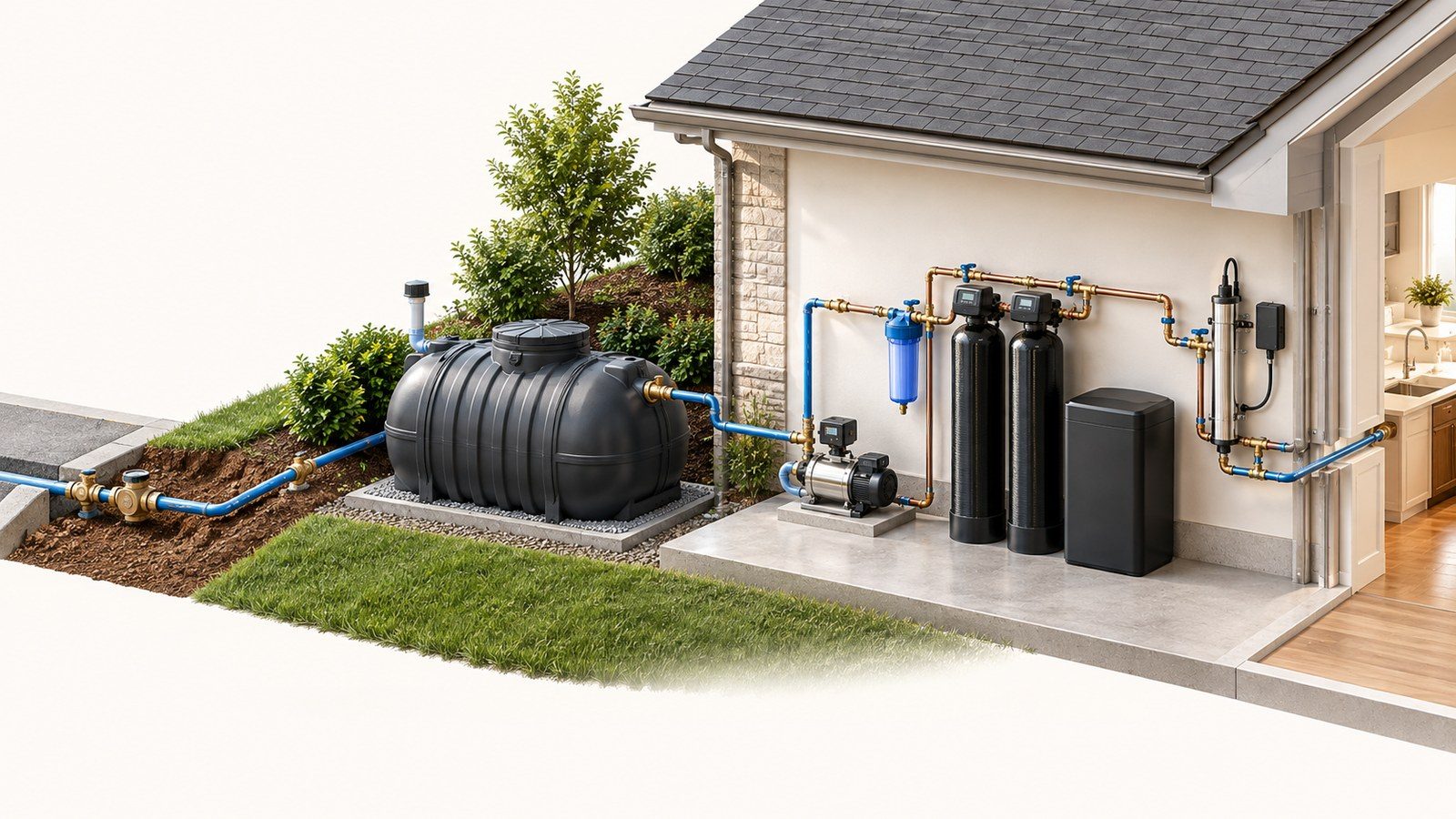
Where the dependency actually sits
It differs sharply depending on where your water comes from, and this is the distinction that matters most.
| Your supply | When the power goes out | How long you have |
|---|---|---|
| Municipal, ground floor | Water usually keeps running on system pressure | Often through the whole outage |
| Municipal, upper floors of a tall building | Booster pumps stop; upper floors can lose pressure | Immediately, above the pressure line |
| Municipal, with a household booster pump | You lose the boost, not the supply | Reduced pressure, still flowing |
| Private well | The pump stops. The water stops. | Whatever is in the pressure tank. Minutes. |
| Stored water with an electric pressure pump | The tank is full and you cannot move it | Until you find buckets |
Read the last two rows together, because that is the trap. A household that bought a water tank specifically for outages, and pressurizes it with an electric pump, has built a system that fails in exactly the event it was bought for.
On a well, this is the whole conversation
A submersible well pump is not a small load. It is a motor lifting water out of the ground, and it draws accordingly — which puts it in a different category from the lights and the refrigerator when you are sizing anything that has to run it.
What you actually have when the power fails is the pressure tank, and a pressure tank holds far less usable water than its label suggests. A tank is rated by total volume; the water you get out before pressure drops below useful is the drawdown, and it is a fraction of that. In practice, a few flushes.
Which means on a well property there is no meaningful difference between a power plan and a water plan. They are one plan, and it has to answer the pump question.
The honest menu
Stored water plus gravity
The only option on this list that needs no electricity at all. An elevated tank, or a tank with a gravity draw point, gives you water when everything else is off. It does not give you household pressure — you are filling containers, not taking showers. Unglamorous and completely reliable.
Stored water plus a small DC or battery-backed pump
Modest power, run from a battery, delivering real pressure for a limited draw. This is the proportionate answer for a lot of households and it is much smaller than people assume, because you are pressurizing from a tank at ground level rather than lifting from a well.
A generator sized to the well pump
The complete answer on a well property, and the most expensive one. It has to be specified against the pump's actual starting load, not its running load — motors draw substantially more at startup, and a generator sized to running load will not start it. PROFESSIONAL CONFIRMATION REQUIRED: this is an electrical sizing question for a licensed electrician, and any permanent installation involves a transfer switch and its own permitting.
Nothing, deliberately
A legitimate choice in town on municipal water at ground level, where the supply usually keeps flowing anyway. Know that you have made it.
The order to think about it in
Most people buy in the wrong order, which is generator first and water later. The sequence that produces a coherent system:
- 1. Establish whether you lose water at all. Municipal at ground level usually does not. Well does, immediately. Everything follows from this.
- 2. Decide what you need water for. Drinking and flushing is a container problem. Showers is a pressure problem. These have different answers and different costs.
- 3. Make sure at least one path needs no power. Whatever else you build, having one way to get water with everything off is the thing that makes the rest optional rather than load-bearing.
- 4. Then size the electrical. By this point you know what has to run, and the generator conversation is a specification rather than a guess.
Where we stop
We design and install water treatment and storage, and we will tell you plainly which parts of what we install need power and what happens to each when it is off. That is a question we think every vendor should answer unprompted and most do not.
We do not size generators, specify transfer switches or do electrical work. That is a licensed electrician's work, and on a well pump it is a real calculation rather than a rule of thumb. What we can do is tell you exactly what load our equipment presents, so whoever does that sizing is working from a number rather than an assumption.
We will tell you what needs power, unprompted
Every piece of equipment we install, what it draws, and what happens to it when the power is off. So whoever sizes your electrical works from a number.
Water resilienceQuestions we get about this
Does my water stop when the power goes out?
How much water is in my well pressure tank?
What size generator do I need for a well pump?
Can I use a water storage tank without electricity?
Sources
- Pressure tank drawdown versus rated volume is a standard characteristic of bladder and diaphragm pressure tanks; your tank manufacturer publishes its drawdown at given cut-in and cut-out pressures.
- Generator sizing against motor starting load rather than running load is an electrical specification matter for a licensed electrician.