 Cahaba Water Co.
What actually happens when the water goes out
Central Alabama Water (formerly Birmingham Water Works) runs roughly 4,100 miles of main. Mains break. Here is what a home water outage actually looks like, and what it takes to not care.
The short version
- Central Alabama Water operates roughly 4,100 miles of water main across 759 square miles.
- A boil-water notice doesn't stop the water — it makes every use a decision.
- Stored potable water with treatment and UV lets the house keep running at normal pressure.
- We won't advertise a number of days. Duration depends entirely on your household's consumption — there's an estimator below.
Most people's plan for a water outage is to have some bottled water in the pantry. That covers drinking. It does not cover a toilet, a shower, a dishwasher, a washing machine, or making coffee for a family on a weekday morning.
This isn't a doomsday article. It's an infrastructure one — the same category as a standby generator or a home battery, and considerably less dramatic than either.
What actually goes wrong
Central Alabama Water serves roughly 770,000 people across 759 square miles through approximately 4,100 miles of water main. That's a system of real scale, and systems of real scale have events.
Main breaks. Buried pipe fails — age, ground movement, temperature swings, construction strikes. Repairs mean isolating a section, which means homes on that section lose supply or pressure.
Boil-water notices. Issued when pressure loss creates a possibility of contamination entering the distribution system. Precautionary, usually. Also disruptive in a way people underestimate until they're in one.
Pressure events. Not a full outage, but enough to make showers unpleasant and appliances misbehave.
None of this is a criticism of the utility. It's what distribution infrastructure does, everywhere.
The part people underestimate: a boil-water notice
An outage is obvious — nothing comes out. A boil-water notice is worse in a specific way, because water keeps flowing and every single use becomes a judgment call.
Can the kids brush their teeth with it? Can you rinse lettuce? Does the dishwasher's sanitize cycle count? What about the ice maker that's been quietly producing ice for two days? Do you need to dump it?
The honest answer to most of those is "boil it or don't use it," and the practical answer is that a household of four burns through an enormous amount of boiled water very quickly. That's when people start buying bottled water by the case — and that's a recurring cost attached to an unpredictable event.
What a storage system actually does
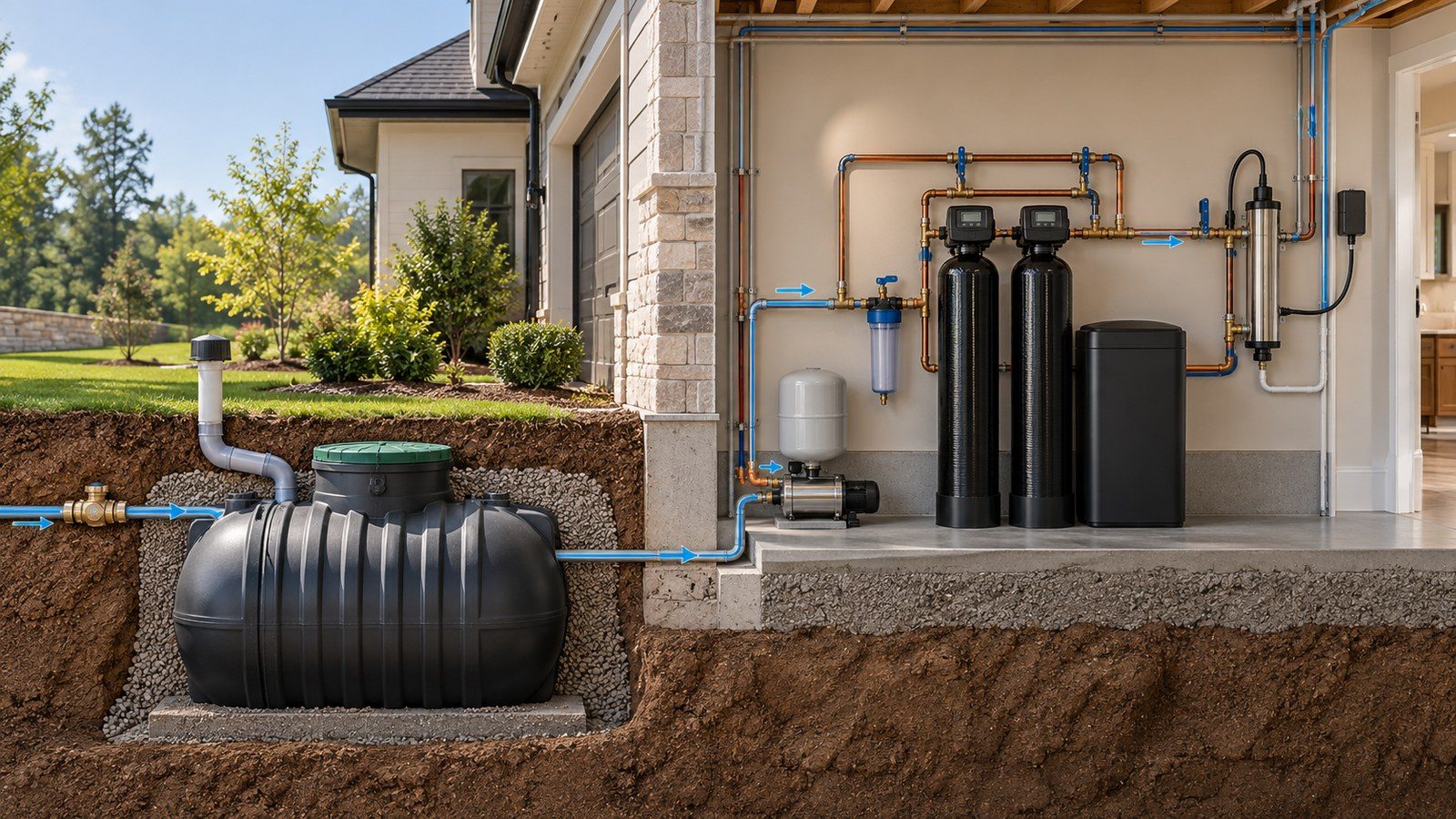
The concept is simple: keep a reserve of treated, potable water on site, and re-pressurize it into the house when the supply is interrupted. The house behaves normally. Showers work. Toilets flush. Nobody rearranges their week.
The sequence we'd use, conceptually:
- Municipal supply — your existing service line.
- Approved fill arrangement with cross-connection protection.
- Potable storage tank — opaque, so light doesn't drive biological growth.
- Variable-speed booster — restores normal household pressure from the reserve.
- Whole-home carbon filtration, sized to design peak flow.
- Softening, where measured hardness warrants it.
- UV disinfection with intensity monitoring.
- Distribution — normal plumbing, normal pressure.
Why UV is not optional here
This is the part that separates a proper storage system from a tank in a garage.
Municipal water arrives with a chlorine residual that protects it through the distribution system. Put that water in a tank and the residual fades — consumed by reactions, dissipated over time. Water that arrived fully protected sits for days or weeks and gradually loses that protection.
Stored water re-pressurized into household plumbing without a residual is a different risk profile from water straight off the main. UV covers that gap, and it's why we won't quote a storage build without it.
The regulatory part nobody should skip
Storing municipal water and returning it to a pressurized household system is a cross-connection control matter. There's a genuine public-health reason for the rules: a poorly arranged connection can allow stored water to flow backward into the public main under the right pressure conditions.
The required arrangement — air gap, backflow assembly type, testing, permitting — is jurisdiction-specific. It depends on your municipality and on the utility, and it is not something to take from a brochure.
The fill and backflow arrangement is reviewed and approved by the licensed plumbing contractor and the relevant utility authority before anything is installed. If a company quotes you a storage system without raising this, they are skipping the step that matters most.
Sizing it — and why we won't sell you "days of water"
You'll see storage marketed as "30 days of water!" That number is meaningless without knowing what a household consumes, and the assumptions behind it are usually not disclosed.
Real reference points:
| Usage mode | Gallons per person per day |
|---|---|
| Normal US household use | 60 – 100 |
| Conscious conservation | 25 – 40 |
| Restricted emergency use — drinking, cooking, basic sanitation | 10 – 25 |
Run the arithmetic on a 500-gallon tank and a family of four:
- Normal use (80 gal/person/day = 320/day): about a day and a half.
- Conservation (30 gal/person/day = 120/day): roughly four days.
- Restricted (15 gal/person/day = 60/day): a little over eight days.
Is it worth it?
Depends entirely on how you weigh the disruption.
If a two-day boil-water notice is a minor inconvenience you'd shrug off, this isn't for you and we'd rather say so. If you work from home, have small children, run a home business, or simply hate having your week rearranged by something outside your control, it's the same calculation as a standby generator — and most people who buy generators aren't expecting the grid to collapse. They just don't want to think about it.
One practical note: a storage system with an electric booster needs power to work. If you're building for resilience, think about water and power together. A generator and a water reserve cover considerably more failure modes than either alone.
Estimate your own duration
Set your storage capacity and daily use and see roughly how long a reserve would last. No fixed 'days of water' claims.
Open the estimatorQuestions we get about this
How long does stored water last in a home water storage system?
Do I need UV with a water storage tank?
Is home water storage legal in Alabama?
What happens during a boil water notice?
Sources
- Central Alabama Water. 2026 Annual Water Quality Report — system size, miles of main and population served.
- US EPA. National Primary Drinking Water Regulations.
- Alabama Plumbers and Gas Fitters Examining Board. Administrative Code, Title 720 — adoption of the 2021 International Residential Code.