 Cahaba Water Co.
Reverse osmosis, explained before it's sold.
On this page: four under-sink systems, four published prices, and what actually separates them.
All four do the same job. What changes is the hardware, the gallons per day, and what each system's own paperwork documents. Where a specification is still pending from the supplier, this page marks it as pending and names it.
equipment · labor · warranty
Every system on this page is an under-sink system. It treats one fixture, typically the kitchen cold line, and the whole installation stays inside the cabinet.
What reverse osmosis actually does.
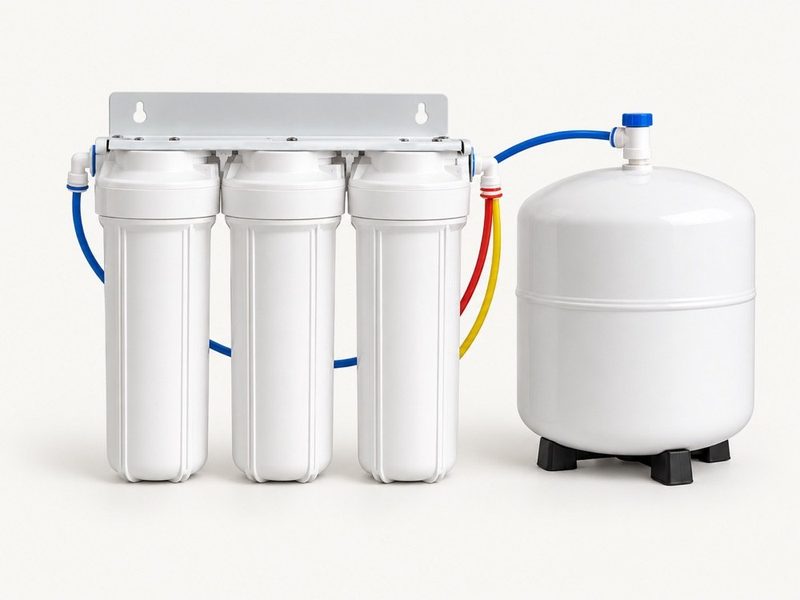
An under-sink RO system is a short row of parts on a bracket in your cabinet. Filters come first. Then the membrane — a sheet that lets water through and holds back a share of what is dissolved in it. Then one last filter, on the way to a faucet of its own.
The membrane is the part that matters. Your household water pressure pushes water against it. Water passes through; a share of what was dissolved in that water does not, and what does not pass goes to the drain. That is the whole idea. Everything else in the cabinet is there to protect the membrane, or to hold what it makes.
Three consequences worth knowing up front. It is slower than a tap, which is why the traditional systems store what they make. It sends water to the drain to do its job. And it has filters you change on a schedule. All three are inherent to the technology, and we plan the installation and the service interval around them.
Each system's certification is stated on that system's own row, in the words its own documentation supports
Production rate and stage count are documented facts about hardware — we publish them as specifications
A stage count is a count of housings. What sits in those housings is described in the row beside it.
Tankless describes where the water is kept. Choose Cahaba Slim 800 for cabinet space and direct-flow production.
Superlatives stay off this page. We rank these systems by price, describe each platform in the words its paperwork supports, and let the certification row speak for treatment.
Birmingham's water meets every federal and state standard. What these systems change is what happens at the tap you drink from, and the utility's own published numbers are on our Birmingham water page.
GPD is a production rate, not a rating. An 800 GPD system makes water faster than a 50 GPD system; the certification row is where treatment is described.
Treatment level and system size are two different decisions.
We keep these two apart, because they answer different things. One asks what this home wants treated. The other asks how much water the house has to move at peak demand.
What does this home want or need treated?
How much water must this home handle at peak demand?
A goal, not a measurement. Taste and odor at the kitchen tap. Chlorine at every shower. Hard water, where a test says it is genuinely high. One more barrier, where that is warranted.
The RO ladder on this page is a treatment-level decision, and it applies to a single fixture.
A plumbing question about the house itself. How wide is the service line, the pipe that brings water in from the street? How many fixtures run at once, and what pressure do we measure at the hose bib?
It belongs to whole-home equipment, which sits in your main water line. An under-sink RO serves a single fixture, so size class stays a whole-home question.
Treatment level comes from what the water needs. Size comes from what the house moves. A big house with six bathrooms, where the only complaint is the chlorine taste, may need our simplest treatment at our largest size. A small house with two bathrooms, where the owner wants everything — filtered water at every tap, softer water, our best drinking-water system, and UV — may need our most complete treatment at our smallest size. Both are correct answers, and every corner of that grid is a real configuration we install.
Three traditional systems, in order of price.
In order of price — the one order the documentation supports. What rises with it is production rate and hardware.
Premium reverse-osmosis drinking water at our lowest installed price.
Homeowners who primarily want better drinking water, with normal household demand and adequate feed pressure.
More production and boosted RO performance.
Homes wanting higher production, or where feed pressure needs support.
Our premium traditional-tank RO system.
Homeowners who want the top traditional RO platform Cahaba offers.
What the ladder ranks is price. Every one of these is a reverse osmosis system doing the same job the same way. What moves up the ladder is production rate, hardware, and what each platform's paperwork documents. Treatment is described per platform, on the certification row of the table below.
The documented differences, in full.
Every cell below comes out of our product file. Where a specification is still pending from the supplier, the cell says so in plain words.
| Documented | Cahaba Pure 50ESSENTIAL | Cahaba Performance 75PERFORMANCE | Cahaba Signature 75SIGNATURE 75 |
|---|---|---|---|
| Installed price | $995All in — equipment, labor, warranty | $1,095All in — equipment, labor, warranty | $1,295All in — equipment, labor, warranty |
| Nominal production | 50 GPD | 75 GPD | 75 GPD |
| Stages | 4 | 5 | Not documented |
| Booster pump | No | Yes | Yes |
| Storage | Approximately 4-gallon metal tank | NSF-certified 3.0-gallon tank | NSF-certified 3.0-gallon tank |
| Faucet | Standard chrome air-gap faucet | Not documented | Not documented |
| Service design | Quick-change cartridges | Not documented | Not documented |
| Certification | IAPMO R&T certifies this configuration to NSF/ANSI 58 and CSA B483.1, including PFOA and PFOS reduction. | The manufacturer identifies the membrane and the storage tank as NSF certified. We do not claim complete-system certification for this platform. | The storage tank is identified as NSF certified. We do not claim complete-system certification for this platform. |
| Best for | Homeowners who primarily want better drinking water, with normal household demand and adequate feed pressure. | Homes wanting higher production, or where feed pressure needs support. | Homeowners who want the top traditional RO platform Cahaba offers. |
| Full page | Cahaba Pure 50 | Cahaba Performance 75 | Cahaba Signature 75 |
Certification is stated per platform. Each of those three sentences describes only the column it sits in
Cahaba Signature 75 is the most expensive of the three, and its documented certification is the narrowest of the three: the storage tank. We put that in the table, in the same row as everything else.
Cahaba Performance 75 produces more per day than Cahaba Pure 50. We do not say it removes more contaminants than Cahaba Pure 50 — no documentation we hold supports that.
We will give you the certifier's listing for whichever system you choose, so you can check the wording above against the source itself.
A fourth system, on its own terms.
Cahaba Slim 800 is the premium space-saving alternative to the traditional-tank systems, at exactly what Cahaba Signature 75 costs. Choose between the two on the shape of the thing in your cabinet and the production rate you want.
Makes drinking water and keeps a few gallons ready in a tank under your sink.
Our premium traditional-tank RO system. A pressurized storage tank in the cabinet, a booster pump, and the platform we consider our best premium traditional RO package overall. That describes the hardware package; what the platform is certified for sits on its own row in the table above.
The specification that separates this platform from Cahaba Performance 75 is recorded in our product file as TBD, pending a documented figure from the supplier. When that figure is on file we will publish it here, and we will tell you the day it lands.
Cahaba Signature 75Makes drinking water on demand, with no tank taking up the cabinet.
High-output RO built around direct flow. Nominal 800 GPD, produced on demand, with the whole cabinet left to you. For homeowners who value cabinet space and fast production.
Certification documentation for this platform is not on file, so this page makes no certification claim for it. The 800 in the name is a production rate, measured in gallons per day.
Cahaba Slim 800Same price, two different shapes. Cahaba Signature 75 is the premium traditional-tank platform. Cahaba Slim 800 is the premium space-saving, high-output platform. Choose the first if a tank suits the cabinet and you want a few gallons held ready. Choose the second if cabinet space or production rate is your real constraint. Tankless describes where the water is kept; each platform's certification is described on its own row.
Three questions, in this order.
Is this about one tap, or the whole house?
If the answer is the kitchen tap — taste, odor, what you drink and cook with — you are on the right page, and the work stays under one sink. If it is chlorine in every shower, or hard water at every fixture, that is a whole-home question, decided separately from this one. Plenty of homes correctly make only one of the two decisions.
Do you need more production, or does your feed pressure need support?
With normal household demand and adequate pressure, Cahaba Pure 50 at $995 is the system, and it is the one we will recommend. If you want higher production, or your feed pressure needs support, the booster-pump platforms start at Cahaba Performance 75. We measure your pressure first, so the recommendation rests on a reading.
Is cabinet space the constraint?
The traditional systems need room for a storage tank next to the filter bracket. If your cabinet is full, or the sink base is shallow, Cahaba Slim 800 frees that space at the same price as Cahaba Signature 75. Send us a photo under the sink and we will tell you which of these fits. We confirm the final price before scheduling.
Answers, before you buy.
What does the GPD number tell you?
How do I choose between tankless and a storage tank?
Why does Cahaba Signature 75 cost more than Cahaba Performance 75?
What does the stage count tell you?
How does an under-sink RO fit with a whole-home system?
Is Birmingham's water safe to drink?
Not sure this is the decision you're making? Whole home
Treatment level and system size get settled separately, and we work that out before quoting. Send us the house and we will tell you which decisions are actually open.