 Cahaba Water Co.
We measure first. Then we recommend.
Three things decide your system. How fast your house uses water. How hard your water is. What your pressure is.
Water treatment is usually sold from a catalog and then fitted to whatever house it lands in. We work the other way around. We measure your house first and specify to what we find, so the system matches your flow, your hardness and your pressure — the three things that actually decide it.
How much carbon you need follows your peak flow.
Peak flow is how much water your house uses in its busiest minute.
Carbon needs time with the water to work, and it sits in a tank on your main line. Push too much water through too little of it and it channels. That means the water carves a path straight through and comes out mostly untreated, at the exact moment your house is busiest.
| Media volume | Application class | Typically suits |
|---|---|---|
| 2.5 cu ft | Up to roughly 10 GPM | Most 2-3 bathroom homes without high-flow fixtures. |
| 3.0 cu ft | Roughly 10-13 GPM | Larger households, 3-4 bathrooms. |
| 4.0 cu ft | Roughly 13-17 GPM | High-demand homes, multiple primary baths. |
| Estate class | 20-25 GPM and above | Genuinely high hydraulic demand. Estate |
How much carbon is a size decision, not a treatment decision. It follows how much water your house moves, and nothing else. You can have any treatment level at any of these sizes. That goes for Essential, Complete and Whole Home Signature Whole home. A bigger tank is better only when your flow actually needs it. How size and treatment level differ.
This is a starting guide, not a hard limit. The published flow rating of the product we pick is the number that counts. Some homes sit right on a line, and when yours does we count your actual fixtures instead of rounding you into a class.
One test answers both questions: whether, and how big.
A softener's size follows a hardness test and how much water you use.
Whether one belongs there at all follows the same test. Hardness varies by water source and location, and it varies more across this metro than most people expect — five utilities serve our service area, and their published hardness spans 2.2 to 13.1 grains per gallon. Central Alabama Water alone covers that entire width.
Sizing a softener is arithmetic. Take your grains per gallon, multiply by the gallons you use in a day, then multiply again by the days between regenerations. A regeneration is the cycle where the softener rinses itself clean. Hardness is a straight multiplier in that math, which is exactly why we measure it at your house instead of assuming it.
Central Alabama Water's 2026 report publishes a system range of 2.2 to 13.1 grains per gallon, by source and location. That is slightly hard at one end and very hard at the other, and the high reading is close to six times the low one. Your address decides which end you sit on, and a softener sized for one end is the wrong machine at the other.
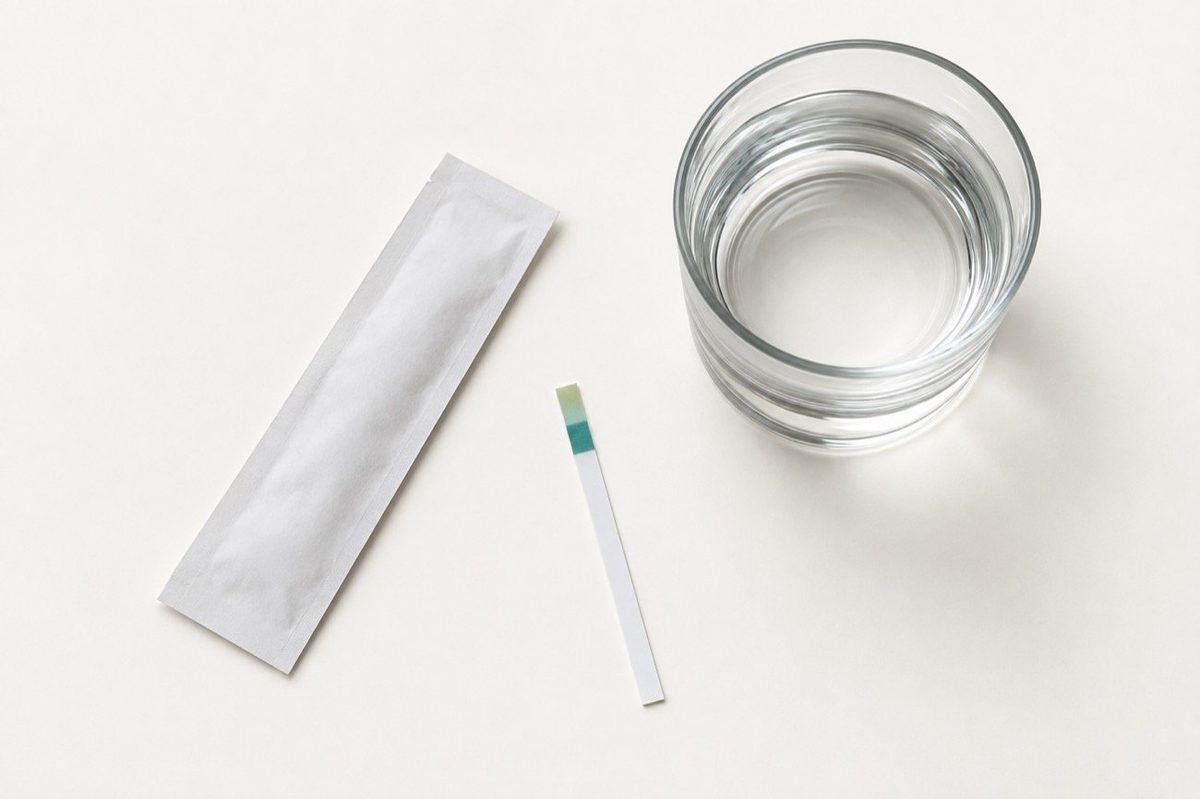
That published range is the reason we test. We mail you a free test strip before we recommend anything, and your reading decides it — a water softener is not automatic in Birmingham. If the number comes back low, we will tell you that. If your hardness level and your goals justify softening, we size the system accordingly.
We measure pressure before we specify a pump.
A booster pump raises pressure. It cannot fix a filter that is too small.
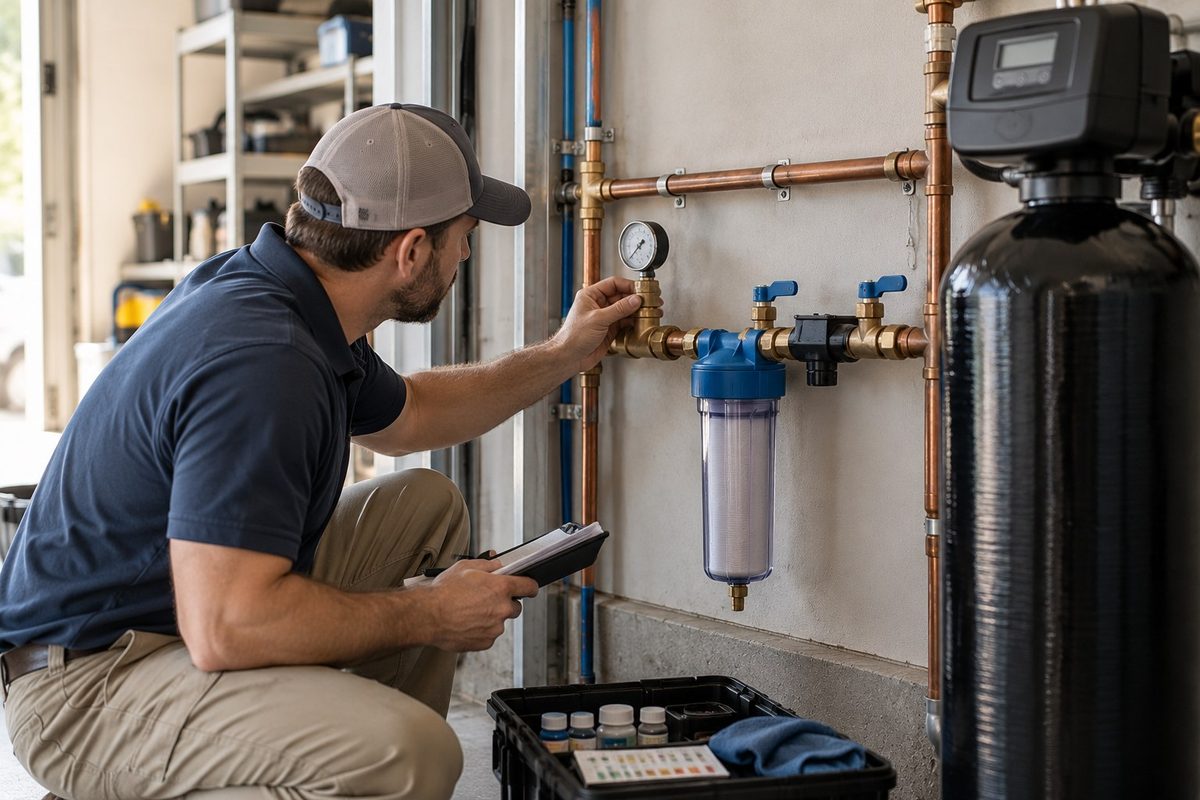
Disappointing pressure often gets answered with a pump. Just as often the cause is a filter too small to pass the water, and a pump sends still more water through carbon that was already struggling. So we find the cause first, and fit a pump where pressure itself is the problem.
Measure static
Your incoming pressure with nothing running. It tells us what the utility delivers at the meter.
Measure dynamic
Pressure while several fixtures run at once. This is the number that matches how the house feels.
Determine peak flow
We count your fixtures and note what kind they are. Then we ask what really runs together. That sets the capacity.
Only after all three do we look at a pump, and only where that pump's own flow and pressure range suits your house. For very large homes we require professional booster sizing, based on flow and head. Head is the pressure the pump has to work against, and every pump we specify comes out of that calculation.
Above roughly 80 psi, a pressure-reducing valve goes in ahead of any treatment equipment. Below roughly 40 psi, we find the cause before we talk about a pump.
Two systems. Each carries its own certification wording.
Both sit under one sink and treat the water at that tap. They are good at different things, so pick on purpose.
- Your drinking and cooking use is normal for a household
- The water pressure feeding it is fine
- IAPMO R&T certifies this configuration to NSF/ANSI 58 and CSA B483.1, including PFOA and PFOS reduction.
- You want it to make more water per day
- Your feed pressure is marginal — that is the pressure reaching the unit. It has a booster pump built in
- The manufacturer identifies the membrane and the storage tank as NSF certified. We do not claim complete-system certification for this platform.
The two columns are worded differently on purpose. Each product carries exactly the words its own documentation supports, and a certification stays with the product that holds it. All four systems, and the exact wording each one carries, are on the drinking-water page.
Optional on city water. Standard on stored water.
Where UV earns its place.
On Birmingham city water, UV is an extra barrier, not a correction. The utility already disinfects and meets every standard. UV earns its place when water is stored before it reaches your taps. The disinfectant left in the water fades while it sits in a tank. We size UV to your peak flow, and it watches its own intensity so you know when the lamp output drops.
Ready to be measured?
The assessment covers your water, your flow, your pressure and your space. That is everything a correct specification needs, and it takes a few minutes.