 Cahaba Water Co.
When the water stops, the house keeps running.
Treated municipal water, stored on site and re-pressurized into the home. The same category as a standby generator or a home battery — infrastructure, not doomsday equipment.
notices, outages
indoor or outdoor
and monitored UV
sign off the fill
Birmingham's water is reliable. Storage covers the interruptions.
The Central Alabama Water (formerly Birmingham Water Works) system runs roughly 4,100 miles of water main across 759 square miles. Mains break. Boil-water notices get issued. Pressure events happen. That is the ordinary arithmetic of infrastructure at that scale, and the utility restores service. Storage is about the hours in between.
A storage system keeps those events in the background. The house draws from a treated reserve, at normal pressure, until service is restored. Your week carries on as planned.
We're deliberate about how this is sold. It belongs in the same conversation as a standby generator or a home battery: a considered piece of home infrastructure that most people never think about until the one week they need it.
Supply, storage, treatment, house.
A conceptual sequence, shaped to your home — not a fixed specification. The fill arrangement in particular varies by jurisdiction and is reviewed before anything is installed.
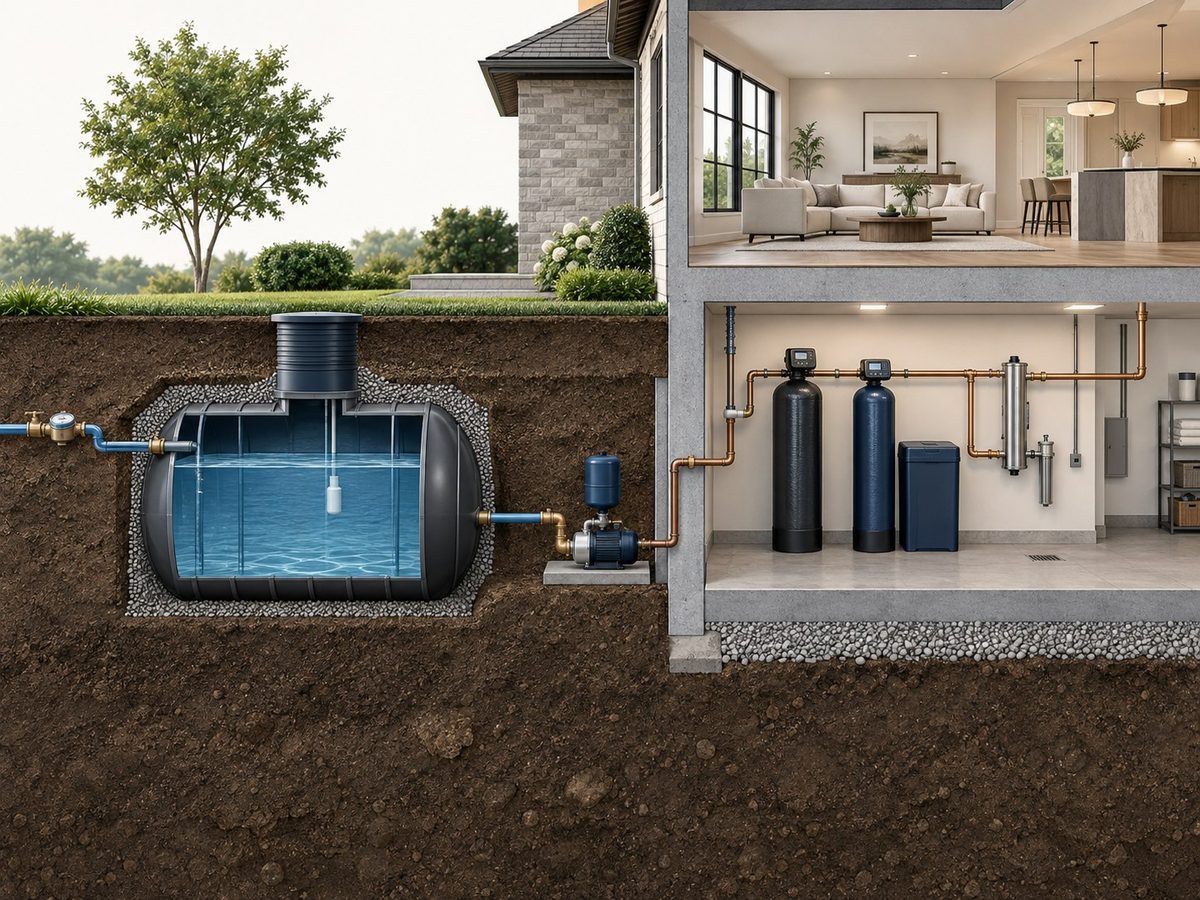
The fill and backflow arrangement is reviewed and approved by the licensed plumbing contractor and the relevant utility authority before installation. Storing potable water and returning it to a pressurized household system is a cross-connection matter. We raise it on the first call, because it shapes both the design and the permit.
Sized to the space you actually have.
| Configuration | Nominal capacity | Notes |
|---|---|---|
| Outdoor, opaque | 305 gallons | Smaller footprint. Suits a side yard or equipment pad. |
| Outdoor, opaque | 500 gallons | The common choice where space allows. |
| Indoor / freestanding | 300 gallons | Garage or basement. Confirm floor loading - water weighs roughly 8.34 lb per gallon. |
| Indoor / freestanding | 500 gallons | Around 4,170 lb when full. Structural review required. |
| Multiple tanks, manifolded | 1,000 gallons and up | Tanks plumbed together as one reserve. No fixed ceiling - if you have the room, we can size to it. |
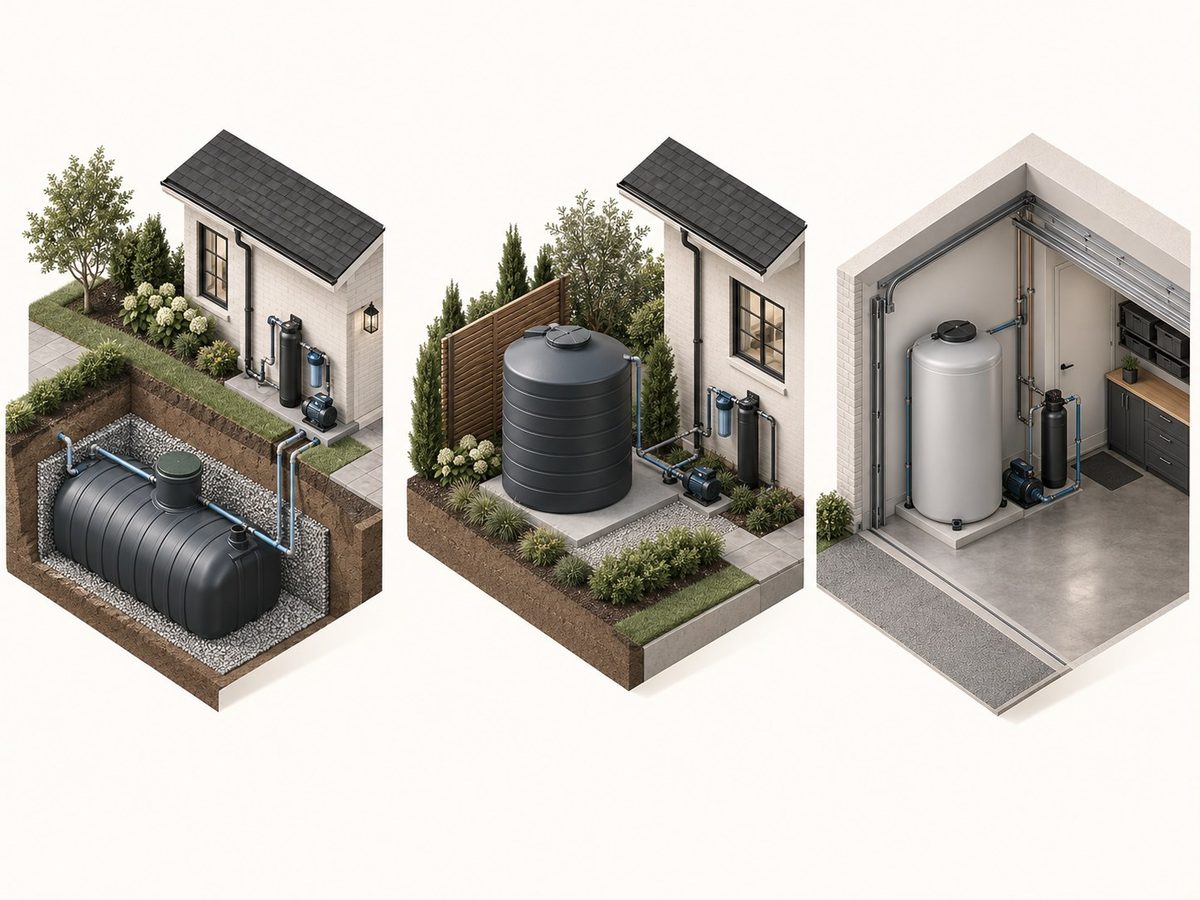
There is no fixed ceiling on capacity. Tanks manifold together, so the limit is your site rather than our product line - available space, access for delivery, freeze exposure, floor loading, and the fill arrangement your municipality and utility approve. Tell us the room you have and we will size to it.
Depends entirely on what you use.
Duration follows your household's emergency consumption, so the useful figure is the one you work out for yourself. Set your own assumptions and see.
For reference: normal US household use runs 60-100 gallons per person per day. Restricted emergency use - drinking, cooking, basic sanitation, minimal laundry - is commonly planned nearer 10-25 gallons per person per day. Your real figure depends on your household and how you'd actually behave.
Rain is free. What you do with it decides how hard it is.
Two very different projects wear the same name.
In Alabama, collecting rainwater on your own property is treated as a property right. The state leaves the decision to you, and for most uses it stays between you and your roofline.
Where it stays easy: outdoor and non-potable use. Irrigation, washing down, topping up a pond. A roof, a gutter, a tank and a pump. It stays clear of the water you drink, so it stays clear of your plumbing permit.
Where it becomes a project: drinking it. Rainwater you intend to drink has to meet water quality requirements. It has to be filtered and disinfected. And it has to comply with the Alabama Plumbing Code. A permit may be required, depending on the size and how it is plumbed. It also has to stay completely separate from the utility supply. That is the same cross-connection question that governs any storage system.
That second version is a permitted, engineered project rather than a product you buy. We will tell you which one you are describing on the first call.
Non-potable collection is straightforward and we can help you plan it
Potable rainwater is possible, and it is a permitted project with real requirements
We will not plumb rainwater into your drinking water without the permits and the treatment that go with it
We do not claim rainwater is cleaner than what Central Alabama Water delivers. It is not
Professional confirmation required. Potable rainwater use involves the Alabama Plumbing Code, your municipality and your water utility's cross-connection control rules. Those are settled before anything is installed, not after.
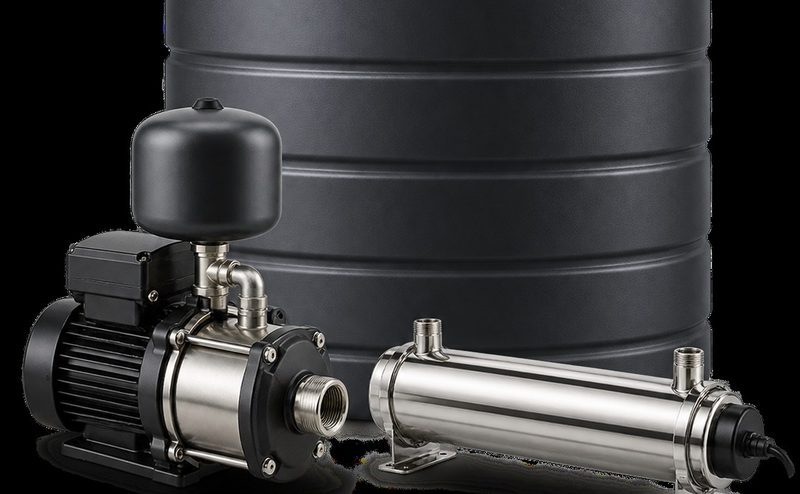
Stored water needs pressure, and pressure needs power.
Water and power fail together more often than separately.
This matters most where there is no municipal pressure to fall back on at all. On a private well the pump stops the moment the power does, which is why storage shows up in nearly every lake house and remote property build we do and only sometimes in town.
The same storms take out both. A tank of water still needs a pump, and a pump needs power. If you already have standby power, sizing the water equipment to run on it is a short conversation. If standby power is still on the list, that is worth sorting out first.
Generators are your electrician's side of the job. What we provide is the load the water equipment draws, so the two systems get specified against each other.
Think of it the way you think about a standby generator: quiet infrastructure that earns its place the first week the main goes down.
Questions we get about this.
Is it legal to collect rainwater in Alabama?
Can you plumb rainwater into my house for drinking?
Is stored water safer than what comes out of the tap?
Do I need a generator for this to work?
How much water do I actually need?
Start with an assessment
Storage sits on top of a properly sized treatment system. We size whole-home systems from actual water demand, then match the tank to your water, your flow and your space.