 Cahaba Water Co.
Why your water smells like a swimming pool — and what actually removes it
Birmingham uses free chlorine rather than chloramine. That single fact determines which filter media is correct, and it's the reason some companies will try to sell you a more expensive one than you need.
The short version
- Central Alabama Water (formerly Birmingham Water Works) disinfects with free chlorine, not chloramine.
- That matters: chloramine needs catalytic carbon. Free chlorine does not.
- Standard high-activity coconut-shell GAC is the correct — and less expensive — specification for this city.
- If someone quotes you catalytic carbon in Birmingham, ask why.
The pool smell is the most common complaint we hear, and it's almost always described the same way: it's worse in the shower, worse in winter, and it seems to come and go.
All three of those observations are correct, and all three have the same explanation.
What you're actually smelling
Central Alabama Water disinfects with free chlorine. Chlorine is added at the treatment plant and a residual is deliberately maintained all the way through the distribution system — that residual is what keeps the water safe across 4,100-odd miles of main between the plant and your tap. It's not an oversight. It's the entire point.
Free chlorine is volatile, which is why you smell it most in the shower: hot water and aerosolization drive it out of solution and into the air you're breathing. It's also why the intensity varies. Utilities adjust residual seasonally, and homes at different points in the distribution network see different levels — generally more near the plant, less at the far end of a run.
Free chlorine and chloramine are not the same problem
This is the part that has real money attached to it.
Many US utilities use chloramine instead — chlorine combined with ammonia. It's more stable, persists further through a distribution system, and produces fewer regulated disinfection byproducts. Good reasons to use it, and a lot of cities do.
But chloramine is considerably harder to remove. It's less reactive, so it needs longer contact time and a different media: catalytic carbon, which is surface-treated to accelerate the reaction. Catalytic carbon costs meaningfully more than standard activated carbon.
| Free chlorine | Chloramine | |
|---|---|---|
| Used in Birmingham | Yes | No |
| Removal difficulty | Straightforward | Considerably harder |
| Correct media | Standard high-activity GAC | Catalytic carbon |
| Required contact time | Shorter | Longer |
| Relative media cost | Lower | Higher |
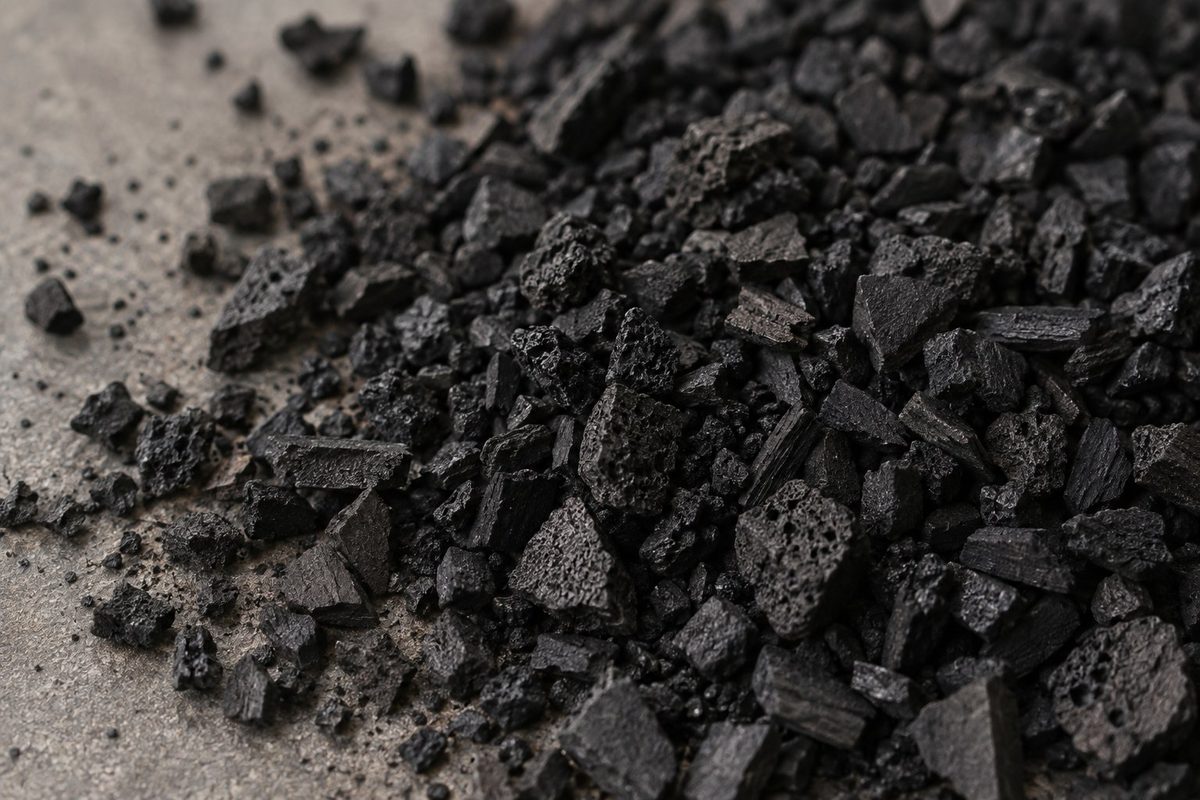
We specify Jacobi AquaSorb coconut-shell activated carbon for Birmingham systems, and we do it because it's the technically correct answer here — not because it's cheaper, though it is. We'll fit catalytic carbon if a customer wants it, and we offer it on the Whole Home Signature system as a genuine upgrade. But we won't present it as a necessity in a city that doesn't use chloramine.
If you get a quote in Birmingham that specifies catalytic carbon as a requirement, it's worth asking which disinfectant the quote assumes. The answer tells you how carefully the system was specified.
Why coconut shell, specifically
Activated carbon is made from several base materials — coal, wood, coconut shell — and they aren't interchangeable.
Coconut-shell carbon has a predominantly microporous structure, which suits small molecules like chlorine and many taste-and-odor compounds. It's also harder and more abrasion-resistant than coal-based carbon, so it holds up better through years of backwashing without breaking down and producing fines.
For municipal water where the target is chlorine, taste and odor, it's the right structure for the job.
Contact time is the thing that actually decides performance
Here's what most quotes don't tell you: activated carbon doesn't work instantly. It works by adsorption, which requires the water to stay in contact with the media long enough for the chemistry to happen.
The governing number is empty bed contact time — how long a given volume of water spends in the media bed. Two variables set it: how much media you have, and how fast the water is moving through it.
Which means media volume isn't a luxury spec. It's the performance spec.
This is why our systems step 2.5 → 3.0 → 4.0 cubic feet, and why we calculate a design peak flow for your house before quoting. A three-bathroom home with a soaking tub has genuinely different hydraulics from a two-bathroom home, and the same filter will not serve both well.
What carbon won't do
Worth being direct about the limits, because they're where overselling happens.
- It doesn't soften water. Carbon and softening are unrelated processes. If you have scale, carbon won't touch it — and you may not need softening anyway in this city.
- It doesn't reliably eliminate seasonal musty taste at full flow. The geosmin that shows up in Birmingham's water in spring is removable by carbon in principle, but the contact time required is far longer than a whole-home filter provides at household flow rates. Reverse osmosis at the drinking tap is what reliably fixes that one.
- It isn't the right tool for PFOA or PFOS. We don't make that claim for whole-home carbon and you should be skeptical of anyone who does. That's point-of-use RO territory, with a system certified specifically for it.
What to ask before you buy
- Which disinfectant does my utility use? In Birmingham it's free chlorine. If the quote assumes chloramine, it was written for somewhere else.
- How much media, and what kind? Cubic feet and base material. "Premium filtration media" is not an answer.
- What design peak flow was this sized for? If nobody calculated one, nobody sized it.
- Is it backwashing, or cartridge-based? Backwashing systems regenerate themselves. Cartridges need replacing every few months and lose flow as they load.
Those four questions will tell you more about a quote than the brochure will.
Chlorine at every tap
Whole-home carbon filtration with Jacobi coconut-shell media, sized to your home's measured peak flow.
See Whole Home EssentialQuestions we get about this
Does Birmingham use chlorine or chloramine?
What kind of carbon filter do I need in Birmingham?
Why does my shower smell more like chlorine than my drinking water?
Sources
- Central Alabama Water. 2026 Annual Water Quality Report — treatment process and disinfection.
- US EPA. National Primary Drinking Water Regulations.
- Water Quality Association. Chloramine fact sheet.